
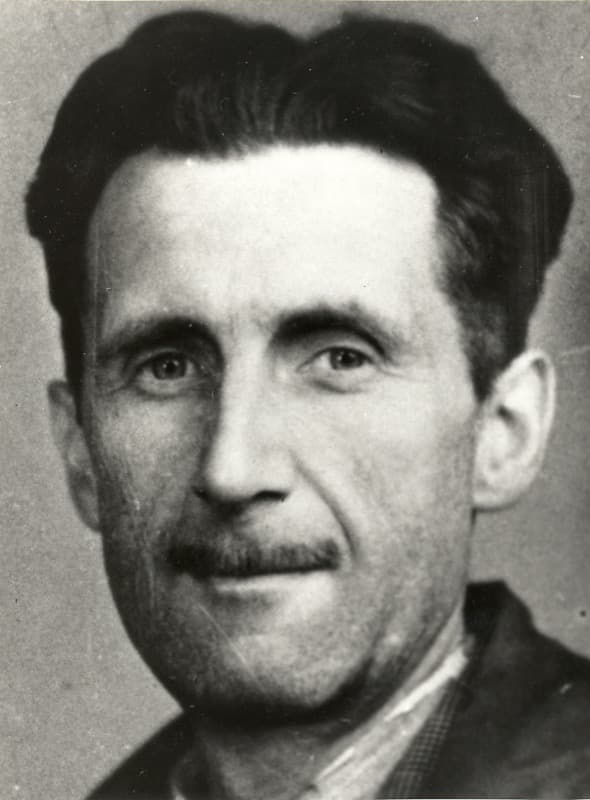
Author
George Orwell
- Lived
- Lived 1903 to 1950
- From
- From English
- Born in
- Born in Motihari, British India
Born Eric Arthur Blair on June 25, 1903, in Motihari, in the Bengal Presidency of British India, where his father Richard Walmesley Blair worked as a sub-deputy agent in the Opium Department of the Indian Civil Service. His mother brought him to England before he was two, and he grew up in modest gentility, what he later called the "lower-upper-middle class." He won a scholarship to Eton, where he was a contemporary of Aldous Huxley and Cyril Connolly, but instead of proceeding to university he joined the Indian Imperial Police in Burma in 1922. Five years of enforcing colonial rule left him with a lifelong hatred of imperialism and a guilt that pervaded his early work. He returned to England, tramped through the slums of London and Paris, experiences recounted in Down and Out in Paris and London (1933), and adopted the pen name George Orwell. The Road to Wigan Pier (1937) documented the miseries of working-class life in the industrial north. In December 1936 he traveled to Spain to fight for the Republic against Franco; a Fascist sniper's bullet passed through his throat, narrowly missing his carotid artery. Homage to Catalonia (1938) records both the idealism and the Stalinist betrayals he witnessed there. Animal Farm (1945), a deceptively simple fable of revolution corrupted, made him famous. He completed Nineteen Eighty-Four (1949), the novel that gave the English language "Big Brother," "doublethink," and "thoughtcrime", while gravely ill with tuberculosis on the Scottish island of Jura. He died in a London hospital on January 21, 1950, at the age of forty-six.
In 1937, fighting fascism on the Aragón front, Orwell was shot through the throat by a sniper, the bullet missing the artery by a hair. He survived only to be hunted through Barcelona by Stalinist agents purging their own side. He came home cured of every illusion, and turned his pen against totalitarianism of any colour.
The first button needs the app on this device; the second gets it there.
In the canon
- Down and Out in Paris and London1933
- Burmese Days1934
- Shooting an Elephant1936
- Keep the Aspidistra Flying1936
- The Road to Wigan Pier1937
- Homage to Catalonia1938
- Coming Up for Air1939
- Animal Farm1945
- Politics and the English Language1946
- 19841949