
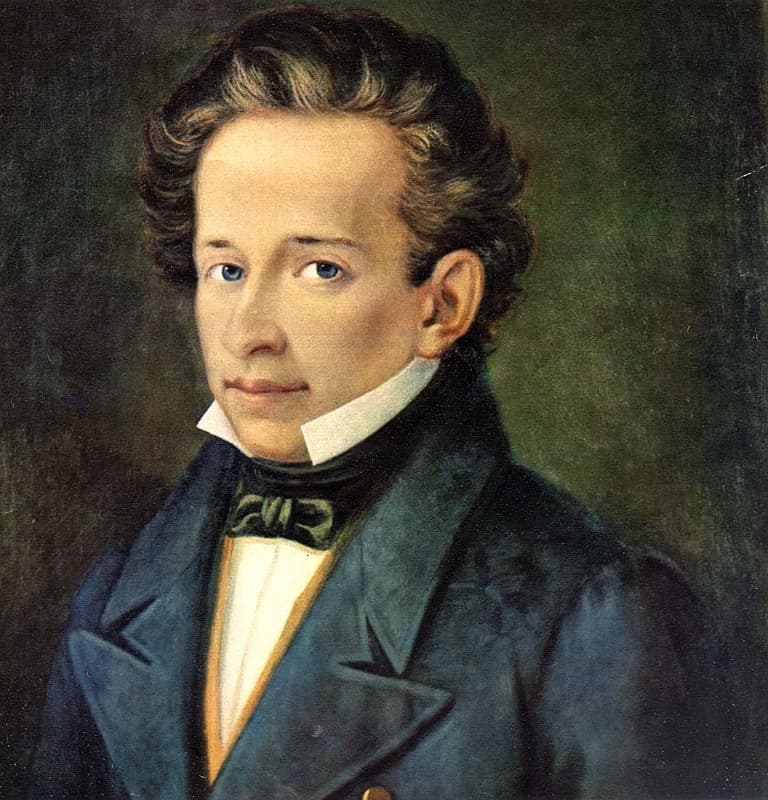
Author
Giacomo Leopardi
- Lived
- Lived 1798 to 1837
- From
- From Italian
- Born in
- Born in Recanati, Papal States
Born Count Giacomo Taldegardo Francesco di Sales Saverio Pietro Leopardi on June 29, 1798, in Recanati, a stagnant hill town in the Papal States, he was the eldest son of Count Monaldo Leopardi, a reactionary provincial nobleman of dwindling means, and Marchioness Adelaide Antici, a woman of rigid piety who ran the household with cold austerity. His father's one generous act was to provide him with a library of ten thousand volumes, and a dispensation to read books on the Index. The boy retreated into it and never entirely emerged. By sixteen he had independently mastered Greek, Latin, Hebrew, and several modern languages, had translated Homer and Virgil, and had written two tragedies, scholarly commentaries, and a history of astronomy. This frenzy of self-education, conducted in near-total isolation, permanently ruined his health: he developed a spinal deformity, near-blindness in one eye, and chronic respiratory illness. From 1817, trapped in Recanati, which he called "this hermitage", he began writing the poems and the philosophical diary (Zibaldone, not published until 1898) that would secure his reputation as the greatest Italian poet since Dante. The idylls "L'Infinito" (1819) and "A Silvia" (1828) distill his vision of human longing in the face of cosmic indifference. His Operette Morali (1827), a collection of satirical philosophical dialogues, anticipates Schopenhauer and Nietzsche. He escaped Recanati when he could, to Rome, Florence, Bologna, Pisa, but poverty and illness always drove him back. In 1833, with the help of his devoted friend Antonio Ranieri, he settled in Naples, where he wrote "La Ginestra" (1836), a final, defiant meditation on human solidarity against an indifferent universe. He died suddenly during a cholera epidemic on June 14, 1837, at thirty-eight.
His father owned a library of ten thousand volumes, and the boy disappeared into it. Through his early teens Leopardi taught himself Greek, Latin, and Hebrew, translated Homer, and wrote scholarship by candlelight in what he called seven years of mad and desperate study. The labour broke his body, curving his spine and half-blinding him before he was twenty.
I can no longer see the light.
The first button needs the app on this device; the second gets it there.
In the canon
- L'infinito1819
- La sera del dì di festa1820
- Dialogue Between Nature and an Icelander1824
- Operette Morali1827
- A Silvia (To Silvia)1828
- Il sabato del villaggio (Saturday in the Village)1829
- Canto notturno di un pastore errante dell'Asia1830
- Il passero solitario (The Lonely Sparrow)1831
- A se stesso (To Himself)1833
- La ginestra (The Broom)1836
- Zibaldone1898