
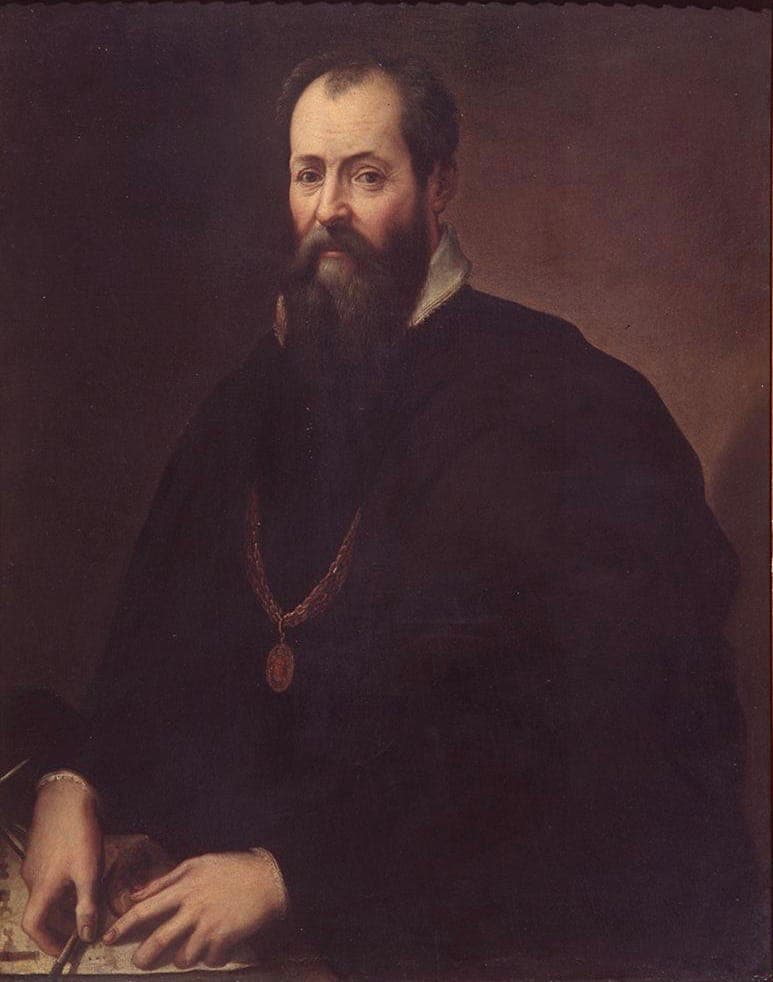
Author
Giorgio Vasari
- Lived
- Lived 1511 to 1574
- From
- From Italian
- Born in
- Born in Arezzo, Italy
Born prematurely on July 30, 1511, in Arezzo, in Tuscany, to a family of modest means, Giorgio Vasari was placed by his older cousin, the painter Luca Signorelli, in the studio of a local stained-glass artist. Sent at sixteen to Florence under the patronage of Cardinal Silvio Passerini, he entered the circle of Andrea del Sarto and his pupils Rosso Fiorentino and Pontormo, and was befriended by Michelangelo, then in his fifties, whose style he loved beyond all others and whose tomb he later designed in Santa Croce. He worked his way through Rome, copying Raphael in the Vatican Stanze, and built a career as a fluent Mannerist painter of frescoes and a successful court architect to the Medici. The Uffizi was his work, conceived as offices for the Florentine magistracies; the long elevated Vasari Corridor, running over the Ponte Vecchio from the Palazzo Vecchio to the Pitti Palace, was built in five months in 1565 for the wedding of Francesco I de' Medici. In 1550 he published the Lives of the Most Excellent Painters, Sculptors, and Architects, a sequence of two hundred biographies from Cimabue to Michelangelo, expanded in 1568. The Lives invented Western art history. They gave the period its name as a rinascita, the rebirth that Jules Michelet would translate into French as Renaissance. They also gave Tuscan art a hierarchy that has shaped every museum visitor since. Knight of the Golden Spur, gonfaloniere of Arezzo, co-founder of the Accademia delle Arti del Disegno in 1563 with Cosimo I and Michelangelo, Vasari died in Florence on June 27, 1574, aged sixty-two, his ceiling Last Judgement at the cathedral unfinished.
In April 1527, as Florence rose against the Medici, defenders of the Palazzo Vecchio hurled furniture from its windows, and a falling bench broke the left arm of Michelangelo's David. By his own account the teenage Vasari and his friend Francesco Salviati slipped into the piazza, gathered the marble pieces and kept them safe until they could be restored.
The first button needs the app on this device; the second gets it there.
In the canon
- Lives of the Artists1550