
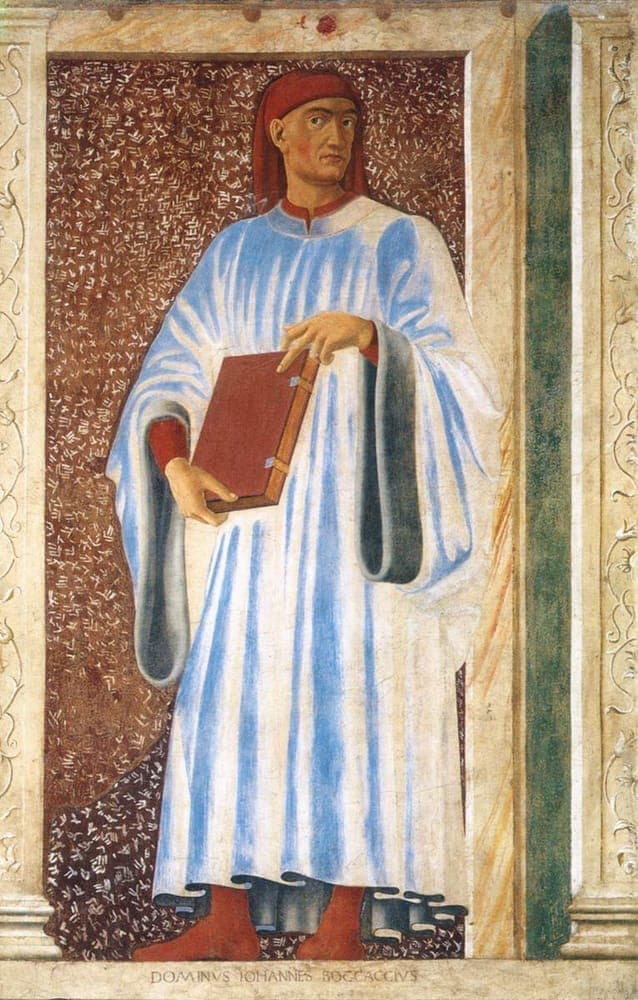
Author
Giovanni Boccaccio
- Lived
- Lived 1313 to 1375
- From
- From Italian
- Born in
- Born in Florence or Certaldo, Italy
Born Giovanni Boccaccio in June or July 1313, most likely in Florence or in the Tuscan town of Certaldo where his father's family had its roots, he was the illegitimate son of the Florentine merchant Boccaccino di Chellino, who worked for the Bardi banking company, and an unknown woman. His father acknowledged him and raised him in Florence, then in 1326 brought him to Naples to apprentice at the Bardi branch there. Boccaccio hated banking. He persuaded his father to let him study canon law at the Studium of Naples, but he spent more time at the French-influenced court of Robert the Wise, reading Ovid and Statius, learning Latin under Paolo da Perugia, and absorbing the southern Italian romance tradition. He returned to Florence in 1340 and was there during the Black Death of 1348, which killed his father and his stepmother and roughly half the city. The Decameron (1353), a hundred tales told over ten days by ten young Florentines who have fled the plague to a villa in the hills above Fiesole, was drafted in the years immediately after. He wrote it in the Tuscan vernacular, in a prose so supple it became the model for Italian prose for the next four centuries. He met Petrarch in 1350 and was bound to him in friendship and discipleship for the rest of his life. He copied codices of the Divine Comedy in his own hand, lectured publicly on Dante at the Badia Fiorentina in 1373, and helped lay the foundations of Florentine humanism. Toward the end he withdrew to Certaldo, harassed by ill health and religious scruple. He died there on December 21, 1375, at the age of sixty-two.
In 1362, the dying Carthusian monk Pietro Petrone sent a fellow friar, Gioacchino Ciani, to warn Boccaccio that his worldly writing endangered his soul. Shaken, Boccaccio resolved to burn his manuscripts and sell his library. Petrarch wrote back at once, arguing there was no contradiction between literature and faith, and talked him out of it.
The first button needs the app on this device; the second gets it there.
In the canon
- Decameron1353