
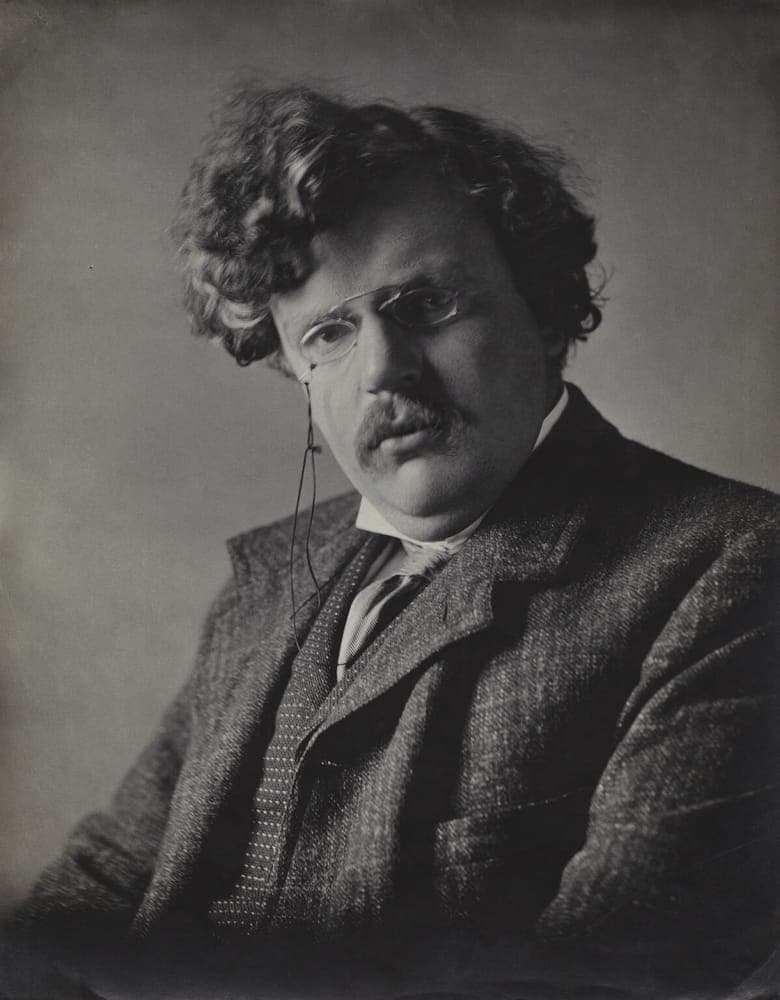
Author
G.K. Chesterton
- Lived
- Lived 1874 to 1936
- From
- From British
Born Gilbert Keith Chesterton on May 29, 1874, in Campden Hill, Kensington, the son of an estate agent and a Swiss-French mother who kept an unbookish, easygoing Unitarian household, he was a slow, dreamy, gigantic child who learned to read late and to draw early. He went to St Paul's School and then to the Slade School of Art with the intention of becoming an illustrator, but stopped attending classes, took up journalism, and never finished a degree. In 1901 he married Frances Blogg, who steered him back to the Anglican faith of his baptism; he would convert to Catholicism in 1922. He wrote with the speed and prodigality of a man who never used a typewriter, dictating to a secretary while drawing or eating, sometimes both. The Daily News gave him a weekly column in 1902, the Illustrated London News followed in 1905, and for the next thirty years he stood at the centre of English letters as a debater of Shaw, Wells, and Bertrand Russell, the public face of paradox. The Man Who Was Thursday (1908), the comic nightmare of anarchists and policemen on the Council of Days, came the same year as Orthodoxy, his rambunctious confession of faith. The Father Brown stories, beginning with The Innocence of Father Brown (1911), gave English detective fiction its little Catholic priest based on a real one, Father John O'Connor. He produced more than a hundred books in all, including The Everlasting Man (1925), which helped convert C. S. Lewis. He died of heart failure at his home in Beaconsfield on June 14, 1936, at sixty-two.
The first button needs the app on this device; the second gets it there.
In the canon
- The Man Who Was Thursday1908
- Orthodoxy1908
- The Innocence of Father Brown1911
- The Everlasting Man1925
- The Poet And The Lunatics1929