
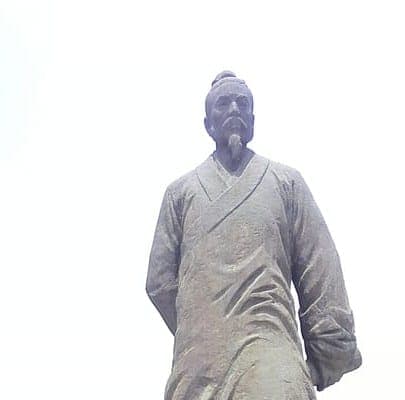
Author
Guanzhong Luo
- Lived
- Lived 1330 to 1400
- From
- From Chinese
- Born in
- Born in Taiyuan, Shanxi
Luo Guanzhong, born Luo Ben, is one of the most consequential and least documented figures in Chinese literature: credited with one of its four greatest novels, yet surviving in almost no verifiable record of his own. Tradition places his birth around 1330 in Taiyuan, in the northern province of Shanxi, though the record is so thin that later scholars have argued for birthplaces as far apart as Hangzhou and Dongping, and for birth years decades apart from each other. He took Guanzhong as his courtesy name and Huhai Sanren, "the Wanderer Among Lakes and Seas," as his pen name, a fitting label for a man whose life reads as a series of departures. He is said to have studied under the novelist Shi Nai'an, and most surviving editions of The Water Margin still credit it as "compiled by Shi Nai'an, edited by Luo Guanzhong." By one long-standing account, he later served in the Suzhou secretariat of Zhang Shicheng, a salt smuggler turned rebel king who rose against the collapsing Mongol Yuan dynasty, and grew disillusioned when Zhang struck a truce with the very rulers he had fought. The only near-contemporary witness to his life is the playwright Jia Zhongming, who recorded meeting an old friend, a recluse who "rarely associated with other people," in 1364, and who admitted decades later that he had no idea what had become of him since. Sometime in his final years Luo compiled Romance of the Three Kingdoms, weaving a millennium of official history, oral storytelling, and stage drama about the fall of the Han dynasty into a sprawling account of three warring states and the men who tried to reunify them. The novel was not printed until 1522, more than a century after his presumed death around 1400, and did not reach the form most readers know today until the Qing-dynasty editor Mao Zonggang revised it in the 1660s, a version so successful it drove every earlier edition from the market.
Luo served in the rebel warlord Zhang Shicheng's Suzhou court through the 1360s, watching him fight the Mongol Yuan then quietly strike a truce with them. Disillusioned by the compromise, Luo turned from statecraft to fiction, channeling what he had seen of shifting allegiance and doomed ambition into a novel about a much older civil war.
The first button needs the app on this device; the second gets it there.
In the canon
- Romance of the Three Kingdoms1400