
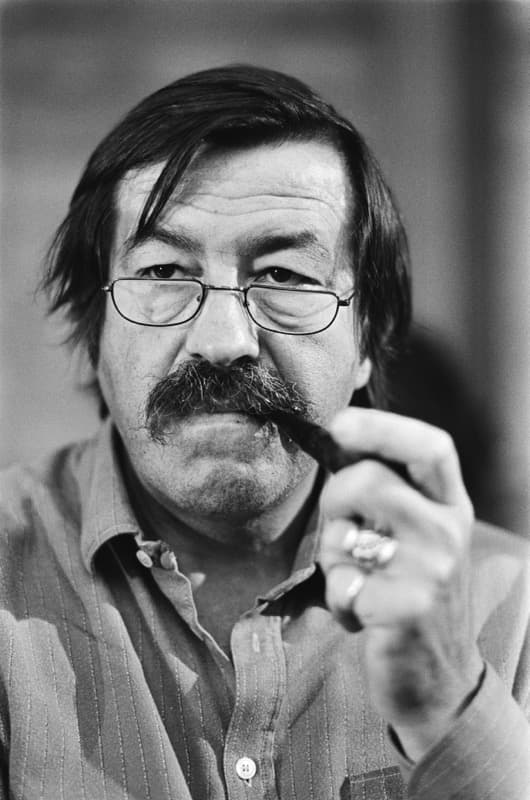
Author
Günter Grass
- Lived
- Lived 1927 to 2015
- From
- From German
- Born in
- Born in Danzig, Free City of Danzig
Born Günter Wilhelm Grass on October 16, 1927, in the Free City of Danzig, now Gdańsk, Poland, the son of a German Protestant father and a Kashubian mother who ran a small grocery store. The city of his childhood, polyglot, contested, destroyed, became the obsessive landscape of his fiction. At fifteen he volunteered for submarine service and was rejected; at seventeen, in late 1944, he was drafted into the Waffen-SS, a fact he concealed for over sixty years. He was wounded, captured by American forces, and held as a prisoner of war until April 1946. After the war he worked as a farmhand, potash miner, stonemason's apprentice, and jazz drummer before studying sculpture and graphic arts at the Düsseldorf and Berlin academies. He moved to Paris in 1956 and there, in a cramped room, wrote Die Blechtrommel, The Tin Drum (1959), the story of Oskar Matzerath, a boy who refuses to grow, narrating the horrors of the Nazi era from beneath a table while beating his tin drum. It became a landmark of European magic realism and the first volume of the Danzig Trilogy, completed by Cat and Mouse (1961) and Dog Years (1963). Grass became the moral conscience of postwar Germany, an outspoken supporter of the Social Democrats and a persistent voice against collective amnesia. In 2006, just before publishing his memoir Peeling the Onion, he revealed his wartime service in the Waffen-SS, provoking a firestorm that many felt undermined decades of moral authority. In 1999 he received the Nobel Prize in Literature for "frolicsome black fables" that "portray the forgotten face of history." He died on April 13, 2015, in Lübeck, at eighty-seven.
In April 2012, at eighty-four, Grass published 'What Must Be Said,' a poem warning that a submarine sale to Israel risked enabling a nuclear strike on Iran. Within days, Israel's interior minister declared him persona non grata under a 1952 law barring former Nazi-organisation members, citing the Waffen-SS service Grass had confessed to six years earlier.
The first button needs the app on this device; the second gets it there.
In the canon
- The Tin Drum1959
- Cat and Mouse1961
- Dog Years1963
- The Flounder1977
- The Meeting At Telgte1979
- Too Far Afield1995
- Crabwalk2002
- Peeling the Onion2006