
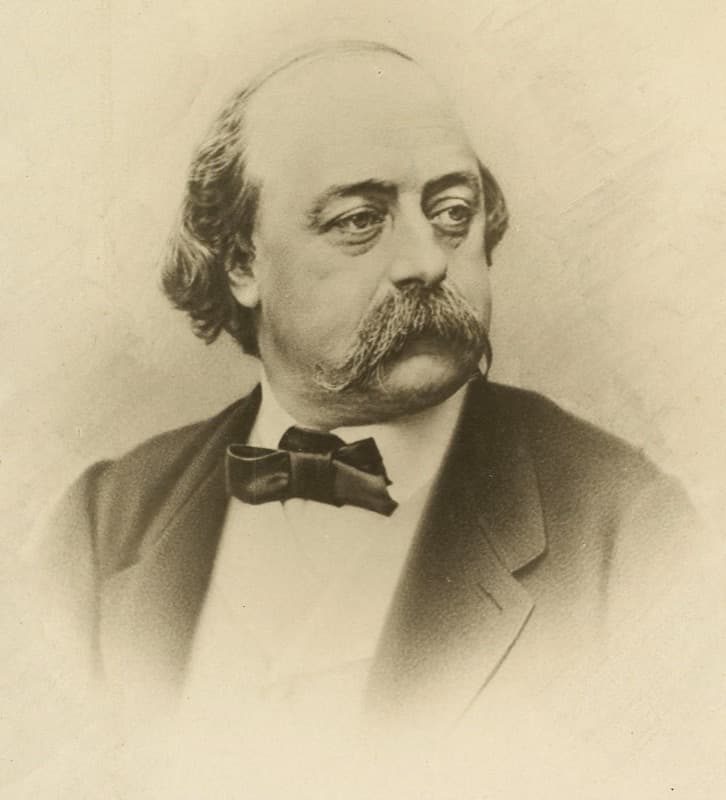
Author
Gustave Flaubert
- Lived
- Lived 1821 to 1880
- From
- From French
- Born in
- Born in Rouen, France
Born on December 12, 1821, in Rouen, Normandy, Gustave Flaubert was the second surviving child of Achille-Cléophas Flaubert, chief surgeon and clinical professor at the Hôtel-Dieu hospital, and Anne Justine Caroline Fleuriot, the daughter of a physician. He grew up in an apartment within the hospital itself, where the garden overlooked the dissecting room, an early proximity to clinical observation that would shape his literary method. He studied law in Paris without enthusiasm and in 1844, at twenty-two, suffered the first of the epileptic seizures that would recur throughout his life; the illness gave him an excuse to abandon the law and devote himself entirely to writing. He settled at Croisset, the family property on the Seine just outside Rouen, and there, in near-monastic seclusion, spent five agonizing years composing Madame Bovary. When it was serialized in the Revue de Paris in 1856, the government prosecuted him for offenses against public morality; his acquittal in February 1857 made the novel a sensation. Flaubert's fanatical devotion to le mot juste, the exact word, and his insistence on authorial impersonality established him as the father of literary realism. Salammbô (1862), a lurid historical novel set in ancient Carthage, bewildered readers expecting another Bovary. Sentimental Education (1869), a panoramic chronicle of disillusion set against the Revolution of 1848, was coolly received but is now considered among the great European novels. Three Tales (1877) contains "A Simple Heart," perhaps his most perfect work. He was laboring over the satirical encyclopedic novel Bouvard and Pécuchet when he died of a cerebral hemorrhage at Croisset on May 8, 1880, at fifty-eight. His protégé Guy de Maupassant was among those at the funeral.
In 1849 he climbed the Great Pyramid at dawn, and at the summit he found a card pinned to the stone: Humbert, Frotteur, a floor-polisher advertising his services, with an address in his native Rouen. The sublime and the provincial, collapsed into one another. It was the whole of his art in miniature.
The first button needs the app on this device; the second gets it there.
In the canon
- Madame Bovary1857
- Salammbô1862
- A Sentimental Education1869
- The Temptation of Saint Anthony1874
- Three Tales1877
- A Simple Soul1877
- A Simple Heart1877
- Bouvard et Pécuchet1881
- Bouvard and Pécuchet1881
- The George Sand-Gustave Flaubert Letters1921
- Flaubert in Egypt1972