
Author
Hafez
- Lived
- Lived 1315 to 1390
- From
- From Persian
- Born in
- Born in Shiraz, Persia
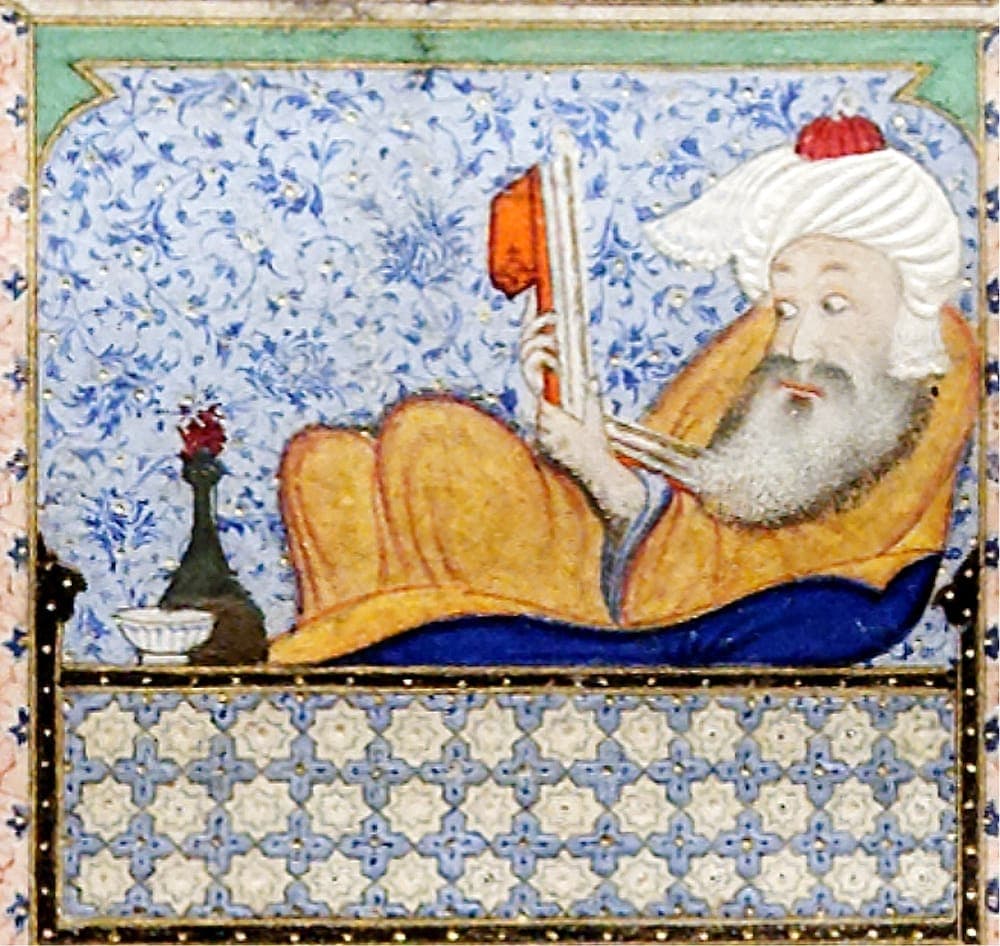
Born around 1315 in Shiraz, in what is now southern Iran, Khwaja Shams-ud-Din Muhammad Hafez-e Shirazi took his pen name, meaning 'one who has memorized,' from the feat of learning the entire Quran by heart as a boy, reportedly by listening to his father recite it. He came of age as a poet at the court of the Inju ruler Shah Abu Ishaq, whose patronage from 1343 gave the young Hafez his first audience of readers. That world ended in 1353, when the Muzaffarid conqueror Mubariz al-Din seized Shiraz, banned wine and Sufi dancing, and closed every tavern in the city, earning himself the bitter nickname muhtasib, morality inspector, from the poet he had silenced. In 1358 Mubariz al-Din's own son, Shah Shuja, deposed and blinded him, reopened the taverns, and became Hafez's great patron for the next twenty-six years, the period in which most of the roughly five hundred ghazals that make up his life's work were written, dense, musical love lyrics in which wine, the beloved, and the divine are often impossible to tell apart. Hafez appears never to have left Shiraz, the city of his birth, even as his verses travelled far beyond it. He died there in 1390, six years after Shah Shuja, and his scattered poems survived only because a friend, Mohammad Golandam, gathered them from memory and manuscript into a single Divan around 1410. His tomb in Shiraz's rose gardens, rebuilt in 1935, remains one of Iran's most visited literary shrines, and to this day many Iranians open his Divan at random for guidance, a practice called fal-e Hafez. Centuries later, his poetry crossed into Europe, inspiring Goethe's West-ostlicher Divan and drawing praise from Ralph Waldo Emerson, who called him the prince of Persian poets.
When the Muzaffarid conqueror Mubariz al-Din seized Shiraz, he banned wine and Sufi dancing and shut every tavern in the city; Shirazis nicknamed him muhtasib, morality police. Hafez answered from inside his own poems, asking God to keep that door bolted against hypocrisy rather than reopen it for men like his new ruler.
The first button needs the app on this device; the second gets it there.
In the canon
- The Divan of Hafez1390