
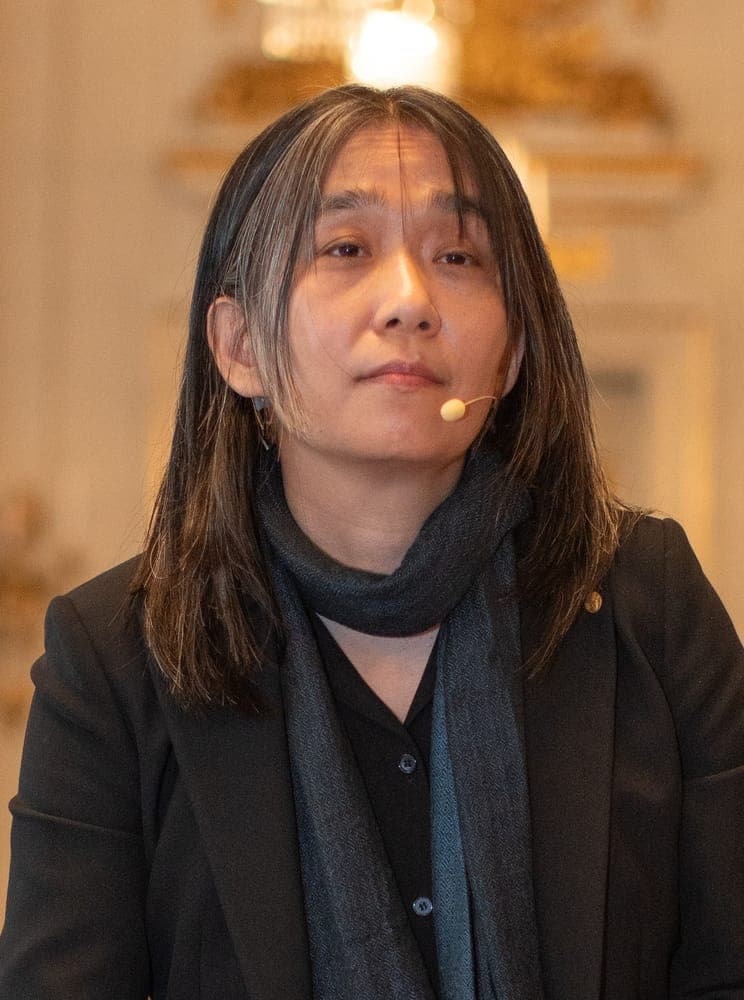
Author
Han Kang
- Lived
- Lived born 1970
- From
- From South Korean
- Born in
- Born in Gwangju, South Korea
Han Kang was born on November 27, 1970, in Gwangju, South Korea, the second of three children in a family steeped in books: her father, Han Seung-won, was a novelist, and both her brothers would also become writers. In January 1980 the family sold their house and moved to Seoul, leaving Gwangju only months before the military massacre of protesters and students there that May. At twelve, home alone, she found on a shelf a photograph book documenting the killings, printed and passed hand to hand in secret by survivors and the bereaved; the images stayed with her for decades. She studied Korean literature at Yonsei University, graduating in 1993, the same year five of her poems appeared in the quarterly Literature and Society. Her fiction debut followed in 1994, when the short story 'The Scarlet Anchor' won the Seoul Shinmun's New Year Literary Contest, and she published her first novel, Black Deer, in 1998. She taught creative writing at the Seoul Institute of the Arts from 2007 to 2018. The Vegetarian (2007), about a woman who stops eating meat and then eating altogether, became the first Korean-language novel to win the International Booker Prize, in 2016, shared with translator Deborah Smith. Human Acts (2014) returned directly to the Gwangju massacre, narrated through the voices of its dead and its survivors. We Do Not Part (2021), rooted in the 1948 to 1949 Jeju uprising, appeared in English in 2025 and won the National Book Critics Circle Award for fiction the following year, the first such win for a Korean writer. In October 2024, Han was awarded the Nobel Prize in Literature, becoming the first South Korean and the first Asian woman to receive it, honored for prose that confronts historical traumas and exposes the fragility of human life. She lives in Seoul, where she also opened and ran, with her son, the independent bookshop Chaekbang Onul, from 2018 until its closure in 2026.
At twelve, home alone, Han pulled a plain volume from a shelf: the Gwangju Photo Book, images of students and protesters beaten and shot by soldiers, printed and passed hand to hand in secret by survivors and the bereaved. Her family had left Gwangju for Seoul only months before the massacre. Three decades later, the memory became Human Acts.
The first button needs the app on this device; the second gets it there.
In the canon
- The Vegetarian2007
- Human Acts2014
- We Do Not Part2021