
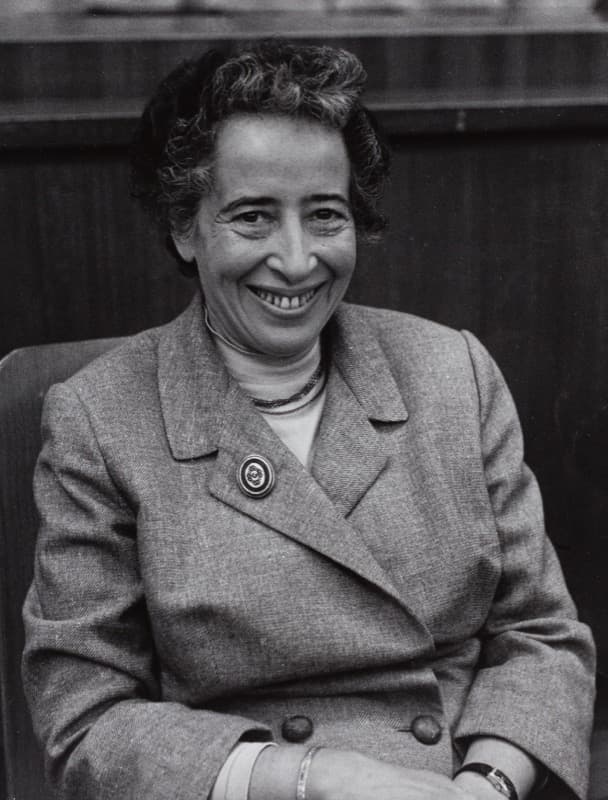
Author
Hannah Arendt
- Lived
- Lived 1906 to 1975
- From
- From German-American
- Born in
- Born in Hanover, Germany
Born Johanna Arendt on October 14, 1906, in Linden, a district of Hanover, Germany, the only child of Paul Arendt, an engineer, and Martha Cohn Arendt. Her father died of syphilis when she was seven, and she was raised by her mother in Königsberg, East Prussia, the city of Kant. She studied philosophy at the University of Marburg under Martin Heidegger, with whom she also had an intense and secretive love affair at the age of eighteen, before completing her doctoral dissertation, Love and Saint Augustine (1929), under Karl Jaspers at Heidelberg. In 1933, after being briefly arrested by the Gestapo for her research into antisemitic propaganda, she fled Germany, first to Paris, where she worked for Jewish refugee organizations, and then, after internment in the Gurs camp in 1940, to New York, where she arrived in 1941 with her second husband, the Communist philosopher Heinrich Blücher. She became an American citizen in 1951, the same year she published The Origins of Totalitarianism, a sweeping analysis of Nazism and Stalinism that established her as one of the foremost political thinkers of the century. The Human Condition (1958) offered a radical rethinking of political action, labor, and work. In 1961 she covered the trial of Adolf Eichmann in Jerusalem for The New Yorker; her report, Eichmann in Jerusalem (1963), introduced the controversial phrase "the banality of evil", the idea that monstrous deeds can be committed by terrifyingly ordinary men. The backlash was fierce, particularly from the Jewish community. At the time of her death she was at work on The Life of the Mind, her final philosophical inquiry into thinking, willing, and judging. She died of a heart attack on December 4, 1975, in her New York apartment, while entertaining friends, at sixty-nine.
In May 1940 France interned her at Gurs as an enemy alien, one of seven thousand Jewish women behind the wire. Weeks later the country fell, the guards' orders dissolved, and in the confusion she and about two hundred others secured release papers and walked out. Many who stayed were later sent to Auschwitz.
The first button needs the app on this device; the second gets it there.
In the canon
- The Origins of Totalitarianism1951
- The Human Condition1958
- What Is Freedom?1961
- Between Past and Future1961
- Eichmann in Jerusalem1963
- On Revolution1963
- Walter Benjamin: 1892-19401968
- The Life of the Mind1978