
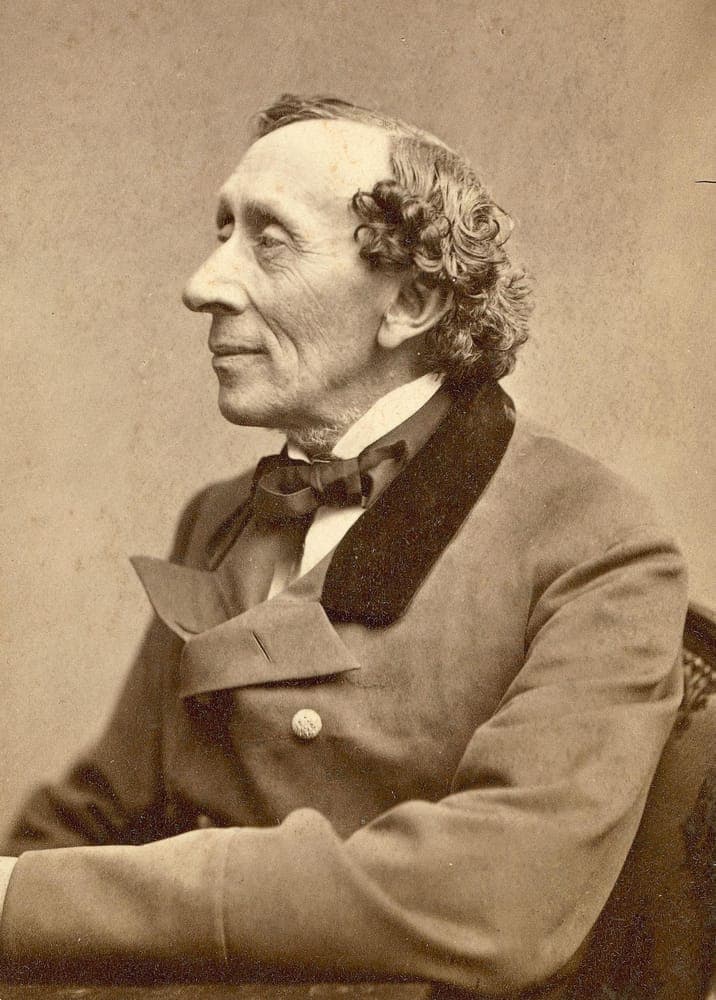
Author
Hans Christian Andersen
- Lived
- Lived 1805 to 1875
- From
- From Danish
- Born in
- Born in Odense, Denmark
Born on April 2, 1805, in Odense on the Danish island of Funen, the son of an illiterate washerwoman and a young shoemaker who would die when the boy was eleven, leaving the family in destitution, Hans Christian Andersen grew up in a single attic room and was sent at fourteen to Copenhagen with the savings of his godmother and a recommendation to seek work at the Royal Danish Theatre. He had a fine soprano voice that broke a few months after his arrival. The theatre's director Jonas Collin took pity on him and persuaded King Frederick VI to fund a grammar-school education at Slagelse, where the schoolmaster lodged him in his own house and abused him so cruelly that Andersen later said those years were the darkest of his life. His first novel The Improvisatore (1835) won him European fame, but it was the small volume of nine stories he published the same year, Fairy Tales Told for Children, that gave him immortality. Across the next forty years the collection grew to one hundred and fifty-six tales translated into more than one hundred and twenty-five languages: The Emperor's New Clothes (1837), The Little Mermaid (1837), The Steadfast Tin Soldier (1838), The Ugly Duckling (1843), The Snow Queen (1844), The Little Match Girl (1845). He fell unrequitedly in love with the soprano Jenny Lind, who told him she could only love him as a brother; she became, by some accounts, the model for the Snow Queen. He died on August 4, 1875, at the age of seventy, of liver cancer, at the country house Rolighed near Copenhagen, having asked a composer to keep the funeral march to the time of a child's steps.
In 1857, Andersen came to stay with Charles Dickens for a fortnight and remained five weeks, once weeping face down on the lawn over a bad review. After he left, Dickens pinned a note in the guest room: 'Hans Andersen slept in this room for five weeks, which seemed to the family AGES.'
The first button needs the app on this device; the second gets it there.
In the canon
- Fairy Tales and Stories1835
- The Emperor's New Clothes1837
- The Wild Swans1838