
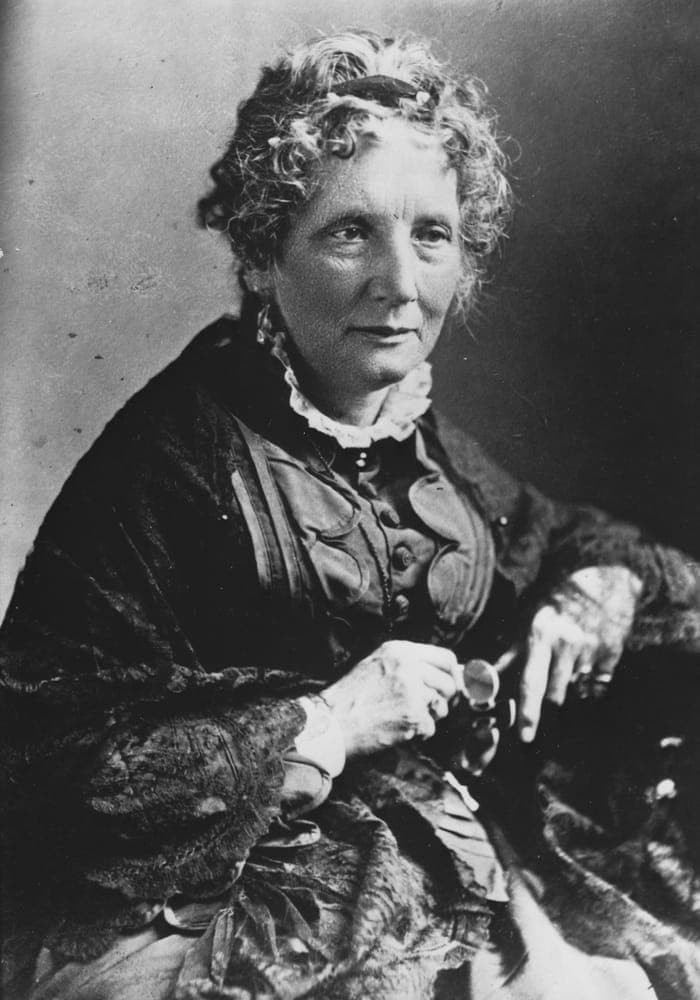
Author
Harriet Beecher Stowe
- Lived
- Lived 1811 to 1896
- From
- From American
- Born in
- Born in Litchfield, Connecticut
Born Harriet Elisabeth Beecher on June 14, 1811, in Litchfield, Connecticut, the sixth of eleven children of the Calvinist preacher Lyman Beecher and his deeply religious first wife Roxana Foote, she was five when her mother died, an absence she said marked every later sentence she wrote. Her sister Catharine ran the Hartford Female Seminary, where Harriet received an unusually classical education for a girl of her century. In 1832 the family moved to Cincinnati so her father could preside over Lane Theological Seminary, and she crossed the Ohio River into the slave state of Kentucky, met escaped enslaved people, attended the Lane Debates on slavery, and married Calvin Stowe, a biblical scholar at the seminary, in 1836. They had seven children. Three died young; the oldest, Henry, drowned in the Connecticut River at eighteen. When the Fugitive Slave Act of 1850 made every northerner a potential agent of recapture, Stowe was in Brunswick, Maine, where Calvin taught at Bowdoin. The novel she said came to her in a single vision during a communion service at the college chapel was serialised by the abolitionist paper the National Era beginning in 1851. Uncle Tom's Cabin appeared in two volumes in 1852, sold 300,000 copies in its first year in America and a million in Britain, and was translated into sixty languages. Lincoln, meeting her in 1862, is said to have remarked: so this is the little woman who made this great war. She wrote twenty-nine more books, settled in Mandarin, Florida, after the Civil War, and died in Hartford, Connecticut, on July 1, 1896, seventeen days after her eighty-fifth birthday.
In July 1849 cholera swept Cincinnati, and Stowe's eighteen-month-old son Charley sickened at the family home on Walnut Hills. She watched his last hours unable to ease him, and he died at five in the morning on July 24. She later said the loss taught her what a poor slave mother may feel when her child is torn away.
The first button needs the app on this device; the second gets it there.
In the canon
- Uncle Tom's Cabin1852
- Dred: A Tale of the Great Dismal Swamp1856
- The Minister's Wooing1859