
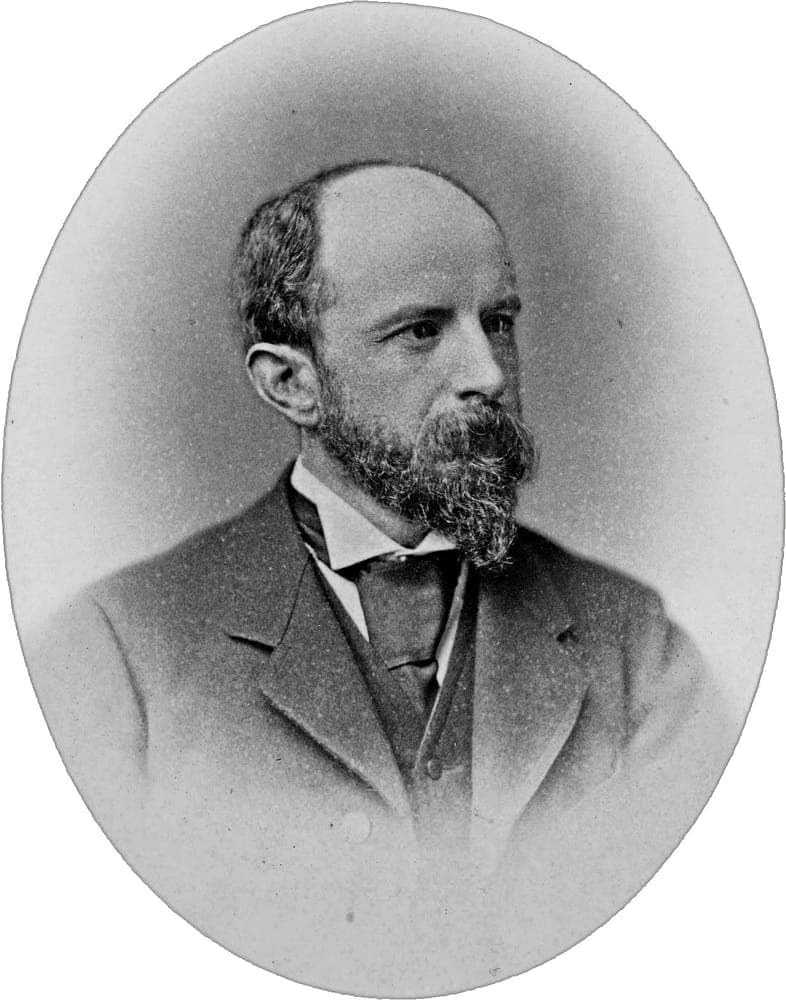
Author
Henry Adams
- Lived
- Lived 1838 to 1918
- From
- From American
- Born in
- Born in Boston, Massachusetts
Born on February 16, 1838, in Boston into one of the most prominent families in the republic, Henry Brooks Adams was the great-grandson of John Adams and the grandson of John Quincy Adams, both presidents of the United States. His father, Charles Francis Adams, served Lincoln as ambassador to the Court of Saint James's. After Harvard, Henry sailed to London as his father's private secretary, watching Confederate diplomacy from a Mayfair desk while writing anonymous dispatches for the New York Times and absorbing John Stuart Mill. He returned to Washington in 1868 as a political journalist, took a chair in medieval history at Harvard in 1870 at the age of thirty-two, and resigned in 1877 to devote himself to history at the highest level. His nine-volume History of the United States during the Administrations of Jefferson and Madison appeared between 1889 and 1891. The death of his wife Clover by potassium cyanide in 1885 silenced him into a long privacy. Out of that silence came Mont-Saint-Michel and Chartres (1904), a meditation on the medieval cathedral as the architecture of unified belief, and its companion The Education of Henry Adams (1907), printed privately and circulated to friends, which presented its author in the third person as a failed product of the new century. The Virgin and the Dynamo, his great image for the loss of spiritual force in the age of electricity, comes from that book. He died in Washington on March 27, 1918, at eighty. The Education was published posthumously, won the 1919 Pulitzer Prize, and was later named by the Modern Library the finest nonfiction book in English of the twentieth century.
At the Paris Exposition of 1900, Adams stood before the great dynamos humming in the Gallery of Machines and felt in them a new religious force, as real to him as the Virgin once was to the builders of Chartres. He was sixty-two, watching the twentieth century arrive as pure, indifferent energy.
The first button needs the app on this device; the second gets it there.
In the canon
- Esther1884
- Mont-Saint-Michel and Chartres1904
- The Education of Henry Adams1907