
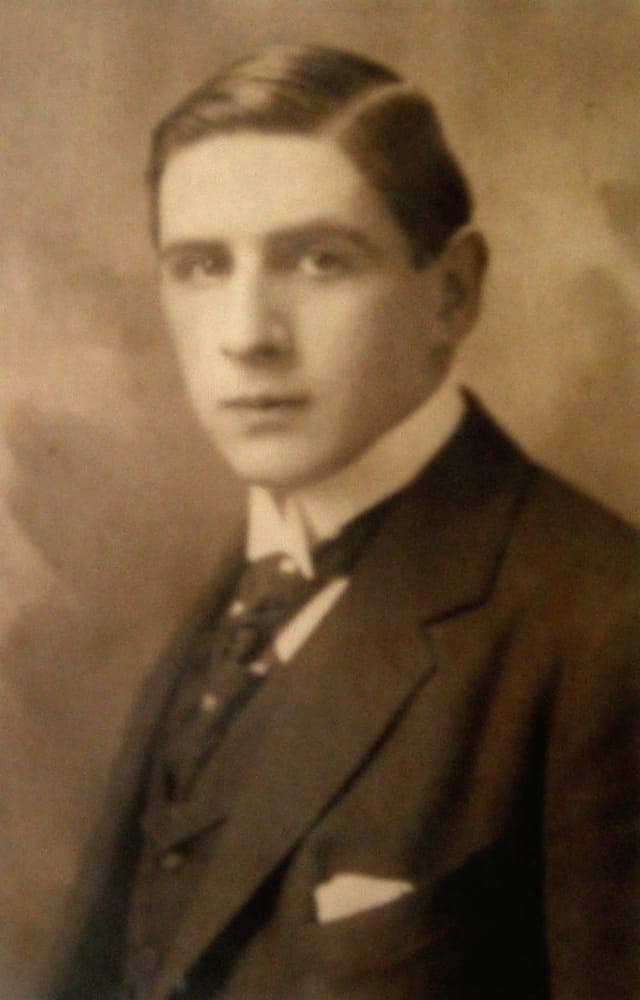
Author
Hermann Broch
- Lived
- Lived 1886 to 1951
- From
- From Austrian
- Born in
- Born in Vienna, Austria
Born Hermann Broch on November 1, 1886, in Vienna into a prosperous Jewish textile family, the eldest son of an industrialist who expected him to take over the family spinning and weaving works at Teesdorf, he was sent to a technical college for textile manufacture and dutifully ran the factory for twenty years while reading philosophy in private. He converted to Roman Catholicism in 1909, married a baroness, divorced her in 1923, and at forty sold the factory to enrol at the University of Vienna to study mathematics, philosophy, and psychology. He began writing fiction at forty. The Sleepwalkers, three loosely linked novels published from 1930 to 1932 and tracking the disintegration of German values across the figures of a Prussian officer, a small-town bookkeeper, and a wartime deserter, made his name; Milan Kundera later named it among the four great novels of central European modernism. After the Anschluss in March 1938 he was arrested for possessing a socialist magazine in the Alpine town of Bad Aussee, held for eighteen days, and finally got out of Austria through an emergency campaign mounted by James Joyce, Thornton Wilder, and the Muirs. He reached the United States in October 1938 and never went back. The Death of Virgil (1945), written in exile, hallucinates the last eighteen hours of the dying Roman poet's life as he resolves to burn the Aeneid; its almost unparagraphed German prose runs to over five hundred pages. He lived in an attic in Princeton in the Kahlers' house, worked on a theory of mass psychology, and was nominated for the Nobel Prize in 1950. He died on May 30, 1951, of a heart attack in New Haven, at the age of sixty-four.
In March 1938, days after the Anschluss, Broch was arrested in the Alpine town of Bad Aussee for possessing a socialist magazine and held eighteen days. James Joyce, Thornton Wilder, and Edwin and Willa Muir mounted an emergency campaign for his release. He reached the United States that October and never returned to Austria.
The first button needs the app on this device; the second gets it there.
In the canon
- The Sleepwalkers1932
- The Death of Virgil1945
- The Guiltless1950