
Author
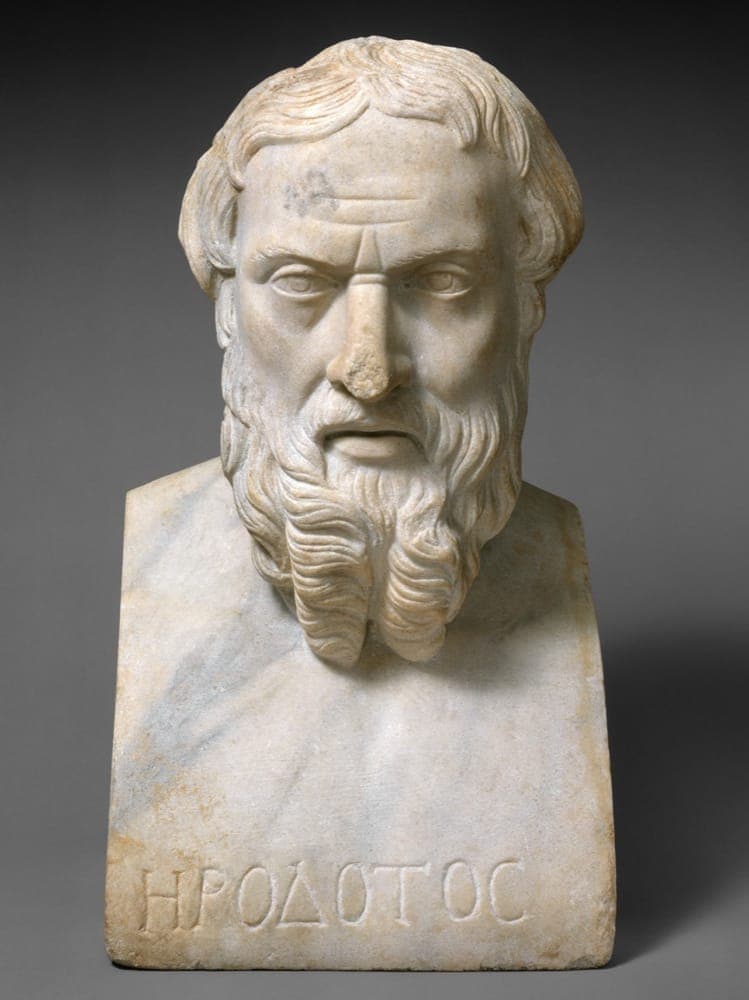
Herodotus
- Lived
- Lived 484 BCE to 425 BCE
- From
- From Ancient Greek
- Born in
- Born in Halicarnassus, Caria (now Bodrum, Turkey)
Born around 484 BCE in Halicarnassus, a Greek city on the southwestern coast of Asia Minor, in present-day Bodrum, Turkey, Herodotus came of age under Persian rule, in a port where Greek, Carian, and Persian worlds met daily. His family was prominent, and a relative, the epic poet Panyassis, was executed by the local tyrant Lygdamis, after which the young Herodotus went into exile on the island of Samos. He became a traveler of extraordinary range, reaching Egypt, Babylon, the cities of the Black Sea coast, and the towns of the Greek mainland, gathering what he saw with his own eyes and what he was told by others. Out of these journeys came The Histories, the earliest surviving work of narrative history in the Western tradition, a long account of the wars between the Greeks and the Persian Empire that climaxes at Marathon, Thermopylae, and Salamis. He opened by declaring his purpose, to preserve the memory of great deeds and to ask why the two peoples came to blows, and the word he used for his enterprise, historie, meaning inquiry, gave the discipline its name. He digressed magnificently, into Egyptian embalming, Scythian burial rites, the courtship of Babylon, and the gold-digging ants of India, and his appetite for marvels earned him the title Father of History from Cicero and, from later skeptics, Father of Lies. He is said to have given public readings of his work at Athens and to have settled at the colony of Thurii in southern Italy. He died around 425 BCE, probably at Thurii, in his late fifties, leaving a book that has never left the conversation it began.
A late tradition, kept in the Byzantine encyclopedia the Suda, has Herodotus reading his Histories aloud at Olympia. In the crowd stood a boy named Thucydides, so moved that his eyes filled with tears. Herodotus turned to the boy's father, Olorus, and called him blessed, because his son had a soul passionate for learning.
The first button needs the app on this device; the second gets it there.
In the canon
- The Histories of Herodotus450 BCE