
Author
Honoré de Balzac
- Lived
- Lived 1799 to 1850
- From
- From French
- Born in
- Born in Tours, France
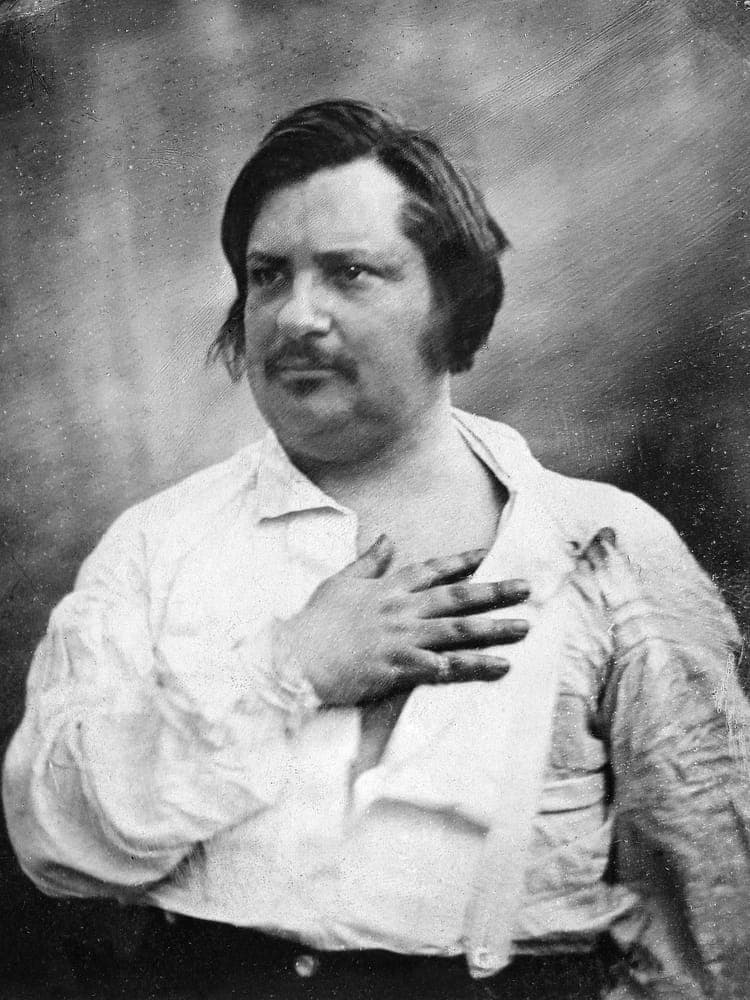
Born Honoré Balzac on May 20, 1799, in Tours, the second child of a self-made functionary from a peasant family in the Tarn who had clawed his way to Secretary of the King's Council and changed his surname from Balssa to the more dignified Balzac, he was sent out to a wet nurse and kept at a frosty distance from his parents for the first six years of his life. From ten to seventeen he boarded at the Oratorian college at Vendôme, where his refusal to learn by rote earned him long stretches in the punishment cell. He was apprenticed to a Parisian law office, then refused law altogether to write in a freezing garret on the rue Lesdiguières on five sous a day. The novel La Peau de chagrin (1831) and Eugénie Grandet (1833) brought him out of obscurity. He added the noble particle to his name on his own authority and conceived La Comédie humaine, a single architectural scheme of about ninety interlinked novels populated by more than two thousand recurring characters, intended to be the natural history of nineteenth-century French society. Père Goriot (1835), Lost Illusions (1837 to 1843), Cousin Bette (1846), and Cousin Pons (1847) are its great central panels. He drank fifty cups of coffee a day to sustain a sixteen-hour writing schedule, ran up enormous debts in failed ventures as printer and publisher, and pursued for sixteen years the wealthy Polish countess Ewelina Hańska, finally marrying her in March 1850. He died on August 18, 1850, in Paris at the age of fifty-one, of heart failure brought on by overwork, with Victor Hugo at his bedside.
Each night Balzac pulled on a white monk's robe, lit fresh candles, and sat down at midnight to write until dawn, breaking only for the thick black coffee that kept him upright. He wrote this way for twenty years, driven as much by creditors circling his door as by the ninety novels taking shape in his head.
The first button needs the app on this device; the second gets it there.
In the canon, 13 works
- The Human Comedy1830
- The Unknown Masterpiece1831
- The Wild Ass's Skin1831
- Colonel Chabert1832
- History of the Thirteen: (Ferragus, The Duchess of Langeais, The Girl with the Golden Eyes)1833
- Eugenie Grandet1833
- Father Goriot1835
- Old Goriot1835
- Lost Illusions1837
- A Harlot High And Low1839
- The Black Sheep1842
- Cousin Bette1846