
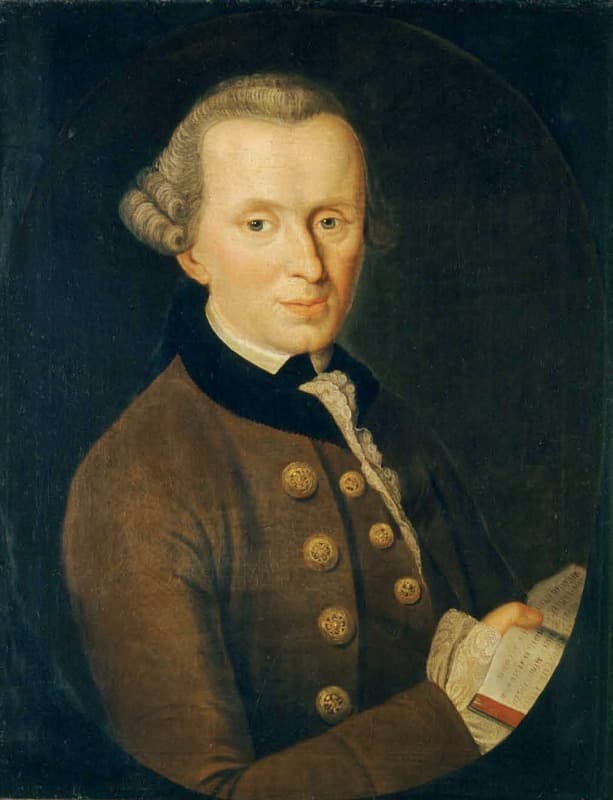
Author
Immanuel Kant
- Lived
- Lived 1724 to 1804
- From
- From German
- Born in
- Born in Königsberg, Prussia
Born on April 22, 1724, in Königsberg, East Prussia, Immanuel Kant was the fourth of nine children in a family of modest means, his father was a harness maker. Raised in the Pietist tradition, he attended the University of Königsberg and spent the rest of his life in that single city, never once venturing beyond its limits. His daily routine became legendary: neighbors set their clocks by his afternoon walk, a schedule he is said to have broken only once, upon reading Rousseau's Émile. Despite this extraordinary regularity he was by all accounts a sparkling conversationalist and a captivating lecturer who entertained frequently. He did not publish his first major work until the age of fifty-seven, when the Critique of Pure Reason (1781) revolutionized Western philosophy by arguing that the mind actively structures experience rather than passively receiving it. The Critique of Practical Reason (1788) grounded morality in the categorical imperative, and the Critique of Judgment (1790) addressed aesthetics and teleology, completing a system of thought that reshaped every subsequent philosophical tradition. His essay "Perpetual Peace" (1795) envisioned an international federation of republican states and anticipated the modern concept of the United Nations. He was appointed professor of logic and metaphysics at Königsberg in 1770 and held the position until declining health forced his retirement. He died on February 12, 1804, at the age of seventy-nine. His last words were reportedly "Es ist gut", it is good.
For eleven years after 1770 Kant published almost nothing, and colleagues wondered whether the professor had run dry. Then he set down the Critique of Pure Reason in four or five months, he told a friend, though the thinking behind it had occupied him for twelve years. That book remade philosophy.
Es ist gut.
The first button needs the app on this device; the second gets it there.
In the canon
- Critique of Pure Reason1781
- Prolegomena to Any Future Metaphysics1783
- Groundwork of the Metaphysics of Morals1785
- Critique of Practical Reason1788
- Critique of Judgement1790
- Perpetual Peace1795