
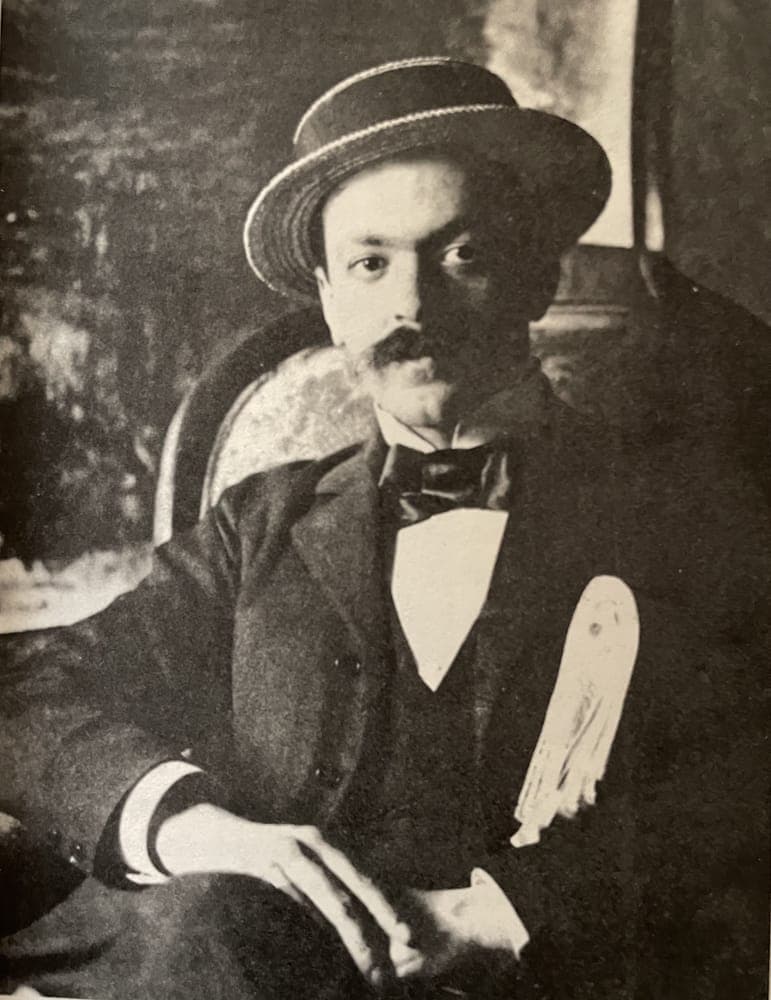
Author
Italo Svevo
- Lived
- Lived 1861 to 1928
- From
- From Italian
- Born in
- Born in Trieste, Austrian Empire
Born Aron Hector Schmitz on December 19, 1861, in the Adriatic port of Trieste, then part of the Austrian Empire, he was the fifth of seven surviving children of a Jewish German glassware merchant and an Italian mother. He spoke the Triestine dialect at home and was sent at twelve to a boarding school near Würzburg to learn German. When his father's business failed in 1880, the boy returned to Trieste and took a clerk's position at the Unionbank of Vienna, where he worked for nineteen years. He published his first novel Una vita (1892) and his second Senilità (1898) under the pseudonym Italo Svevo, 'Italus the Swabian', a name that announced his split linguistic inheritance. Both were ignored. He gave up fiction, joined his father-in-law's underwater-paint business, and lived for years between Trieste and a London suburb. In 1907 he hired a young Irishman named James Joyce to tutor him in English. Joyce read the abandoned novels, told their author they were better than he knew, and twenty years later, after Svevo had quietly returned to writing, championed the new book in Paris and Milan. La coscienza di Zeno (1923), the confessional memoir of a chain-smoking hypochondriac written for his analyst, brought sudden international fame at sixty-three. Eugenio Montale, Valéry Larbaud, and Benjamin Crémieux took up the cause. Svevo had become a model for Leopold Bloom. He died on September 13, 1928, at the age of sixty-six, from injuries sustained in a car crash near Motta di Livenza on the way home from a cure at Bormio. Asked for a final cigarette by his hospital bed, he was refused; that, he murmured, would have been my last.
In 1907, restless in his father-in-law's paint business, Svevo hired a young Berlitz teacher to improve his English. The teacher was James Joyce, who read the two forgotten novels gathering dust in his student's drawer and told him plainly they were better than their author believed.
The first button needs the app on this device; the second gets it there.
In the canon
- As A Man Grows Older1898
- Confessions of Zeno1923