
Author
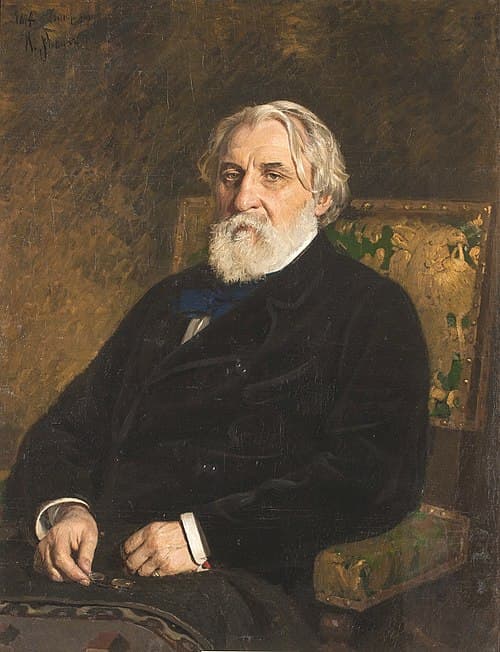
Ivan Turgenev
- Lived
- Lived 1818 to 1883
- From
- From Russian
- Born in
- Born in Oryol, Russia
Born on November 9, 1818, in Oryol, Russia, Ivan Turgenev was the son of a cavalry colonel who had fought against Napoleon in 1812 and a tyrannical, wealthy mother whose cruelty toward her serfs left a lasting mark on his conscience and his fiction. He studied at the universities of Moscow and Saint Petersburg before traveling to Berlin, where he absorbed German philosophy and developed the Western sympathies that would define his career. A Sportsman's Sketches (1852), his first major work, a collection of stories depicting the humanity of Russian peasants, was a milestone of Russian realism and is credited with influencing Tsar Alexander II's decision to emancipate the serfs in 1861. His novels Rudin (1856), A Nest of the Gentry (1859), On the Eve (1860), and Fathers and Sons (1862) charted the intellectual and political currents of Russian society with a psychological delicacy that Flaubert and Henry James deeply admired. Fathers and Sons, with its portrait of the nihilist Bazarov, remains one of the major achievements of nineteenth-century fiction, though it was attacked by both radicals and conservatives upon publication. For much of his later life Turgenev lived abroad, in Baden-Baden and then in Paris, often in the household of the celebrated opera singer Pauline Viardot, with whom he maintained a lifelong attachment. He died on September 3, 1883, of a spinal abscess at his house in Bougival, near Paris, far from the Russia he had spent his life trying to understand.
In 1843, Turgenev heard Pauline Viardot sing in The Barber of Seville in St Petersburg and applauded so hard that people nearby complained. Introduced to her within days, he spent most of his adult life following the singer and her husband across Europe, from Paris to Baden-Baden, and never married.
I am on my death-bed; there is no possibility of my recovery. I write you expressly to tell you how happy I have been to be your contemporary, and to utter my last, my urgent prayer. Come back, my friend, to your literary labors.
The first button needs the app on this device; the second gets it there.
In the canon, 16 works
- Bezhin Meadow1851
- Bezhin Lea1851
- A Sportsman's Notebook1852
- Sketches from a Hunter's Album1852
- A Month In The Country1855
- Rudin1856
- Home of the Gentry1859
- A Nobleman's Nest1859
- A Nest of Nobles1859
- First Love1860
- On the Eve1860
- Fathers and Sons1862