
Author
James D. Watson
- Lived
- Lived 1928 to 2025
- From
- From American
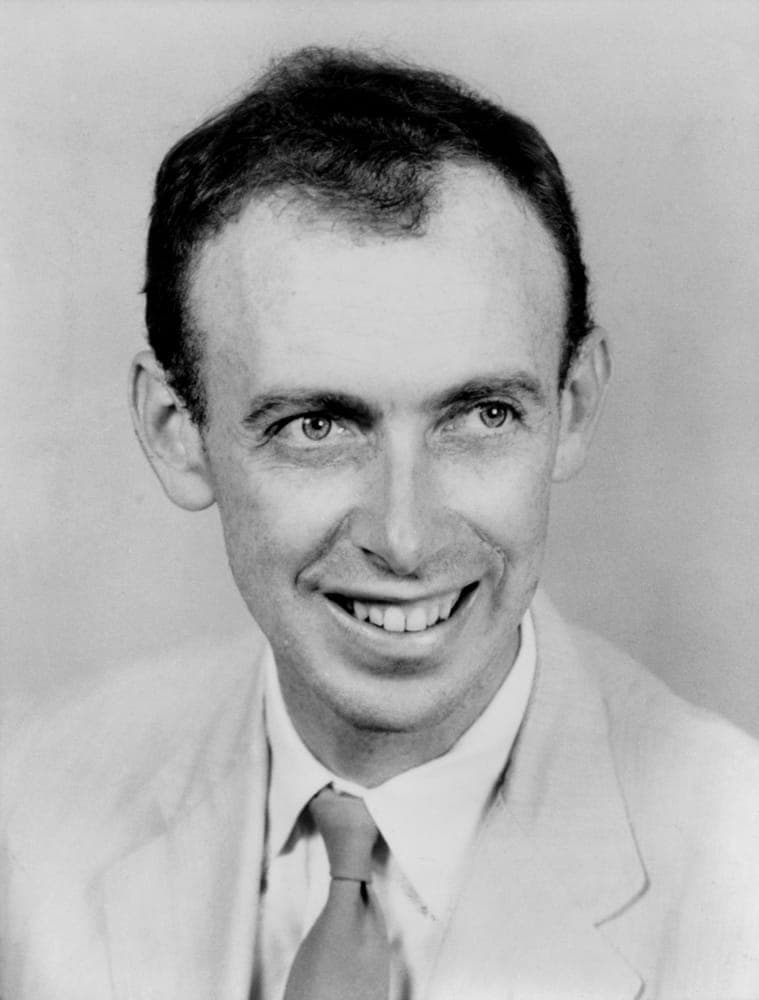
Born James Dewey Watson on April 6, 1928, in Chicago, the only son of a businessman of colonial English descent and an Irish-Scottish mother, he was a precocious bird-watcher raised on the South Side who appeared on the radio show Quiz Kids before he was twelve and entered the University of Chicago at fifteen on a scholarship under the experimental admissions policy of President Robert Hutchins. He took a Bachelor of Science in zoology in 1947 intending to study ornithology. Reading Erwin Schrödinger's What Is Life? that same year turned his ambition from birds to genetics. He took a doctorate at Indiana under the bacteriophage geneticist Salvador Luria, spent a postdoctoral year in Copenhagen with Herman Kalckar, then in October 1951 arrived at the Cavendish Laboratory in Cambridge, where he fell in with the older Francis Crick and, between February and March 1953, building on the X-ray diffraction images of Rosalind Franklin and Raymond Gosling at King's College London, proposed the double helix structure of DNA. The single-page paper in Nature on April 25, 1953, reshaped twentieth-century biology. He shared the Nobel Prize for Physiology or Medicine in 1962 with Crick and Maurice Wilkins; Franklin had died of ovarian cancer in 1958 at thirty-seven and was ineligible. He taught at Harvard from 1956 to 1976, directed Cold Spring Harbor Laboratory from 1968, helped found the Human Genome Project in 1988, and wrote The Double Helix (1968), a brisk and unsparing memoir of the discovery that managed simultaneously to delight readers and damage friendships. Later remarks claiming a genetic link between race and intelligence cost him his honorary titles at Cold Spring Harbor in 2019. He died on November 6, 2025, in East Northport, New York, at the age of ninety-seven.
The first button needs the app on this device; the second gets it there.
In the canon
- The Double Helix1968