
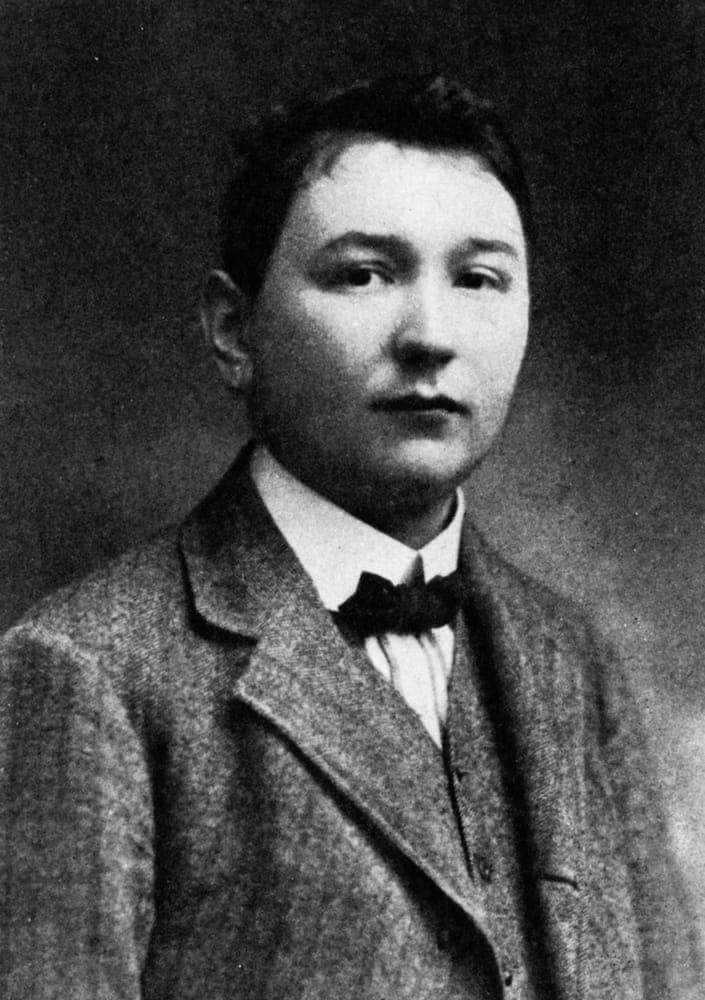
Author
Jaroslav Hašek
- Lived
- Lived 1883 to 1923
- From
- From Czech
- Born in
- Born in Prague, Austria-Hungary
Born on April 30, 1883, in Prague, then the Bohemian capital of the Austro-Hungarian Empire, Jaroslav Hašek was the son of a Catholic mathematics teacher who drank himself to death when the boy was thirteen, leaving his widow and three children to move lodgings more than fifteen times in chasing cheaper rent. Expelled from grammar school after the 1897 anti-German riots, he trained briefly as a druggist, graduated from a Prague business academy, and was fired from the Slavia Bank in 1903 for absenteeism. He took up the bohemian life, walked across Slovakia, Galicia, and the Balkans, writing sketches and travel pieces as he went, and by 1911 had published over a thousand humorous stories. The same year he founded a parody political organisation called the Party of Moderate Progress Within the Bounds of the Law. Conscripted into the Habsburg army in 1915, he was captured by the Russians at Dukla Pass, joined the Czechoslovak Legion, then defected to the Bolsheviks and served as a Red Army commissar in Siberia, married a printing worker in Irkutsk without divorcing his first wife, and returned to Prague in 1920 unrecognised, branded a traitor by old comrades. He retreated to the village of Lipnice nad Sázavou with his second wife to write The Good Soldier Švejk (1921-1923), the picaresque saga of an indomitable Czech idiot adrift in the imperial war machine, satirising authority with such warmth that Švejk became a national archetype. Too ill to write the final volume, he dictated it from his bed. He died on January 3, 1923, of heart disease at the age of thirty-nine, the book unfinished at four volumes of a planned six.
With his wife Jarmila, Hasek registered a business called the Cynological Institute, trading in dogs and tinkering with their pedigrees to pass mongrels off as purebreds. It went bankrupt within two years. When he wrote Svejk a decade later, he gave his hero that exact trade.
The first button needs the app on this device; the second gets it there.
In the canon
- The Good Soldier Švejk1921