
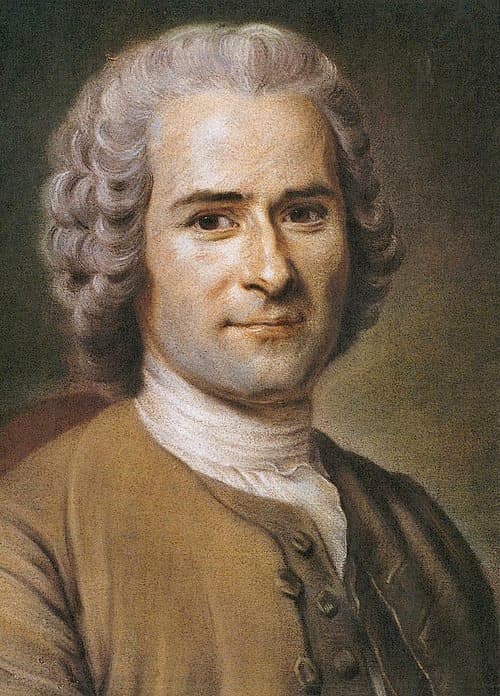
Author
Jean-Jacques Rousseau
- Lived
- Lived 1712 to 1778
- From
- From Swiss
- Born in
- Born in Geneva
Born on June 28, 1712, in Geneva, Jean-Jacques Rousseau lost his mother nine days later, she died of puerperal fever following his birth, a fact that shadowed his entire life. His father, a watchmaker with aristocratic pretensions, raised the boy on classical literature, reading Plutarch aloud to him through the night, but eventually fled Geneva to avoid imprisonment after a quarrel and abandoned the child to relatives. At sixteen Rousseau too fled the city and began a vagabond existence across Savoy and France, converting to Catholicism, taking odd jobs, and educating himself through voracious reading. His Discourse on the Sciences and Arts (1750) won the prize of the Academy of Dijon and made him famous by arguing that civilization had corrupted rather than improved humanity. The Discourse on Inequality (1755) traced the origins of social injustice to private property. Julie, or the New Heloise (1761) became the century's most popular novel. The Social Contract and Émile (both 1762) provoked such outrage from both the French and Genevan authorities that he was forced into years of exile. His Confessions, composed between 1765 and 1770 and published posthumously, invented the modern autobiography. He fathered five children with his companion Thérèse Levasseur and placed all of them in an orphanage, the great contradiction of the man who wrote the most influential treatise on education ever published. In 1778, the Marquis de Girardin invited him to his château at Ermenonville. He died there on July 2, 1778, of a stroke. His remains were transferred to the Panthéon in 1794.
In 1749, walking to Vincennes to visit the imprisoned Diderot, Rousseau read a prize question in a journal: had the progress of the arts and sciences improved morals? In a flash he saw that civilization corrupts the natural goodness of man. He sat down beneath a tree and wept, his waistcoat wet with tears, and rose a different writer.
How beautiful the sky is. Not a single cloud. I am going now to that great Being.
The first button needs the app on this device; the second gets it there.
In the canon
- A Discourse on the Arts and Sciences1750
- Discourse on Inequality1755
- A Discourse on Political Economy1755
- Julie, or the New Heloise1761
- The Social Contract1762
- Émile1762
- Émile, or On Education1762
- The Confessions of Jean-Jacques Rousseau1782
- Reveries of a Solitary Walker1782