
Author
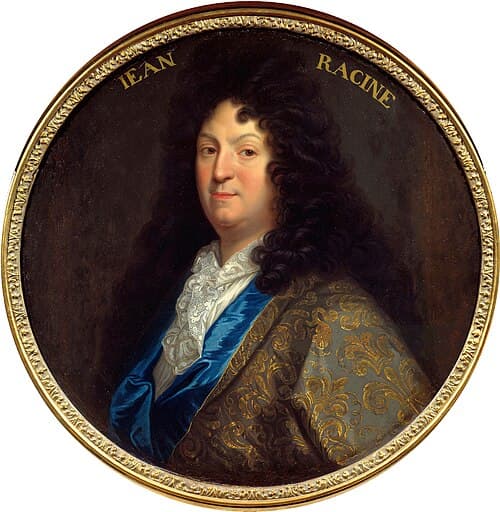
Jean Racine
- Lived
- Lived 1639 to 1699
- From
- From French
- Born in
- Born in La Ferté-Milon, France
Baptized on December 22, 1639, in La Ferté-Milon, a small town northeast of Paris, Jean Racine was orphaned by the age of four, his mother died in 1641, his father in 1643. He was taken in by his grandmother, Marie des Moulins, who brought him to the convent of Port-Royal des Champs, the center of the Jansenist movement, where he received a rigorous classical education in Latin and Greek. The monks of Port-Royal, suspected by the French crown of theological and political subversion, gave Racine the intellectual discipline and the tortured spiritual sensibility that would define his tragedies. He broke with Port-Royal to pursue the theater, an act the Jansenists considered sinful, and produced his first masterpiece, Andromaque, in 1667. Over the next decade he created a body of work, Britannicus (1669), Bérénice (1670), Bajazet (1672), Mithridate (1673), Iphigénie (1674), and Phèdre (1677), that represents the summit of French neoclassical tragedy. His alexandrines achieved what Robert Lowell called a "diamond-edge" and a "hard, electric rage." After Phèdre, he abruptly retired from the commercial stage, married Catherine de Romanet, fathered seven children, and accepted the prestigious post of royal historiographer alongside his friend Nicolas Boileau at the court of Louis XIV. He returned to writing only at the request of Madame de Maintenon, composing the biblical dramas Esther (1689) and Athalie (1691) for the girls' school at Saint-Cyr. He died on April 21, 1699, of a liver tumor, and was buried, by his own request, at Port-Royal.
In his late thirties, at the height of his fame, Racine set down tragedy and became Louis XIV's official historian. With his friend Boileau he followed the king to the front, standing near the sieges of Ghent and Ypres, taking notes for a vast history of the reign that would almost entirely burn after his death.
The first button needs the app on this device; the second gets it there.
In the canon
- Andromache1667
- Britannicus1669
- Bérénice1670
- Iphigénie1674
- Phèdre1677
- Athalie1691