
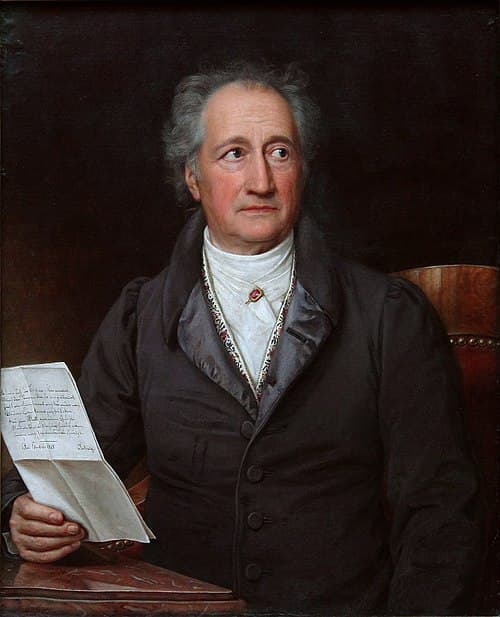
Author
Johann Wolfgang von Goethe
- Lived
- Lived 1749 to 1832
- From
- From German
- Born in
- Born in Frankfurt am Main, Holy Roman Empire
Born on 28 August 1749 in Frankfurt am Main, the eldest surviving child of Johann Caspar Goethe, an imperial councillor, and Catharina Elizabeth Textor, daughter of the city’s mayor, Johann Wolfgang von Goethe grew up in a prosperous household steeped in civic pride and intellectual ambition. He studied law at Leipzig and Strasbourg, but the law never held him , literature did. The Sorrows of Young Werther (1774), an epistolary novel about lovesick despair ending in suicide, made him the most famous writer in Europe almost overnight and triggered a wave of imitative suicides across the continent that authorities tried in vain to suppress. In 1775, Duke Karl August of Saxe-Weimar invited the young celebrity to his court, where Goethe would remain for the rest of his life, serving as privy councillor, theatre director, and minister of state while pursuing simultaneous careers in science, philosophy, and every conceivable literary genre. His Italian journey of 1786–1788 reshaped his aesthetic toward classical form. The friendship with Friedrich Schiller that began in 1794 produced a decade of extraordinary mutual influence , Schiller urged him back to Faust, the work that had haunted him since his twenties. Wilhelm Meister’s Apprenticeship (1795–1796) essentially invented the Bildungsroman. Faust Part One appeared in 1808; Part Two he sealed in a packet to be published only after his death, completing it mere months before he died on 22 March 1832 in Weimar. His final words are traditionally recorded as “More light!” , though his secretary reported the rather less poetic request to open a second shutter.
In October 1808, summoned to the Erfurt congress, Goethe stood before Napoleon, who had read The Sorrows of Young Werther many times and carried it in his campaign library. The emperor studied him a moment and said only, 'You are a man.' Goethe treasured the remark for the rest of his life.
The first button needs the app on this device; the second gets it there.
In the canon
- The Sorrows of Young Werther1774
- The Iphigenie auf Tauris1787
- Wilhelm Meister's Apprenticeship1795
- Roman Elegies1795
- Elective Affinities1809
- Theory Of Colours1810
- Poetry and Truth1811
- Blessed Longing (Selige Sehnsucht)1814
- Italian Journey1816
- Faust1832
- Maxims and Reflections1833
- Poetry And Truth From My Own Life2004