
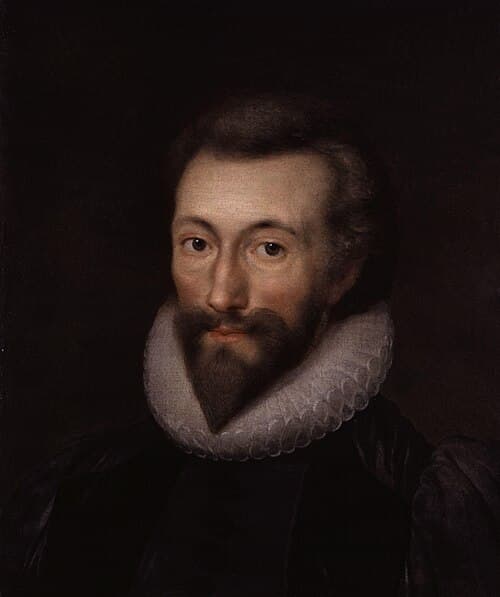
Author
John Donne
- Lived
- Lived 1572 to 1631
- From
- From English
- Born in
- Born in London, England
Born in Bread Street, London, sometime between January and June of 1572, John Donne entered the world already marked by danger: his family were recusant Catholics in Protestant England, and his mother, Elizabeth Heywood, was the great-niece of Sir Thomas More, who had been beheaded for his faith. His younger brother Henry died of plague in Newgate Prison in 1593, arrested for harboring a Catholic priest. Donne studied at Hart Hall, Oxford, from the age of eleven, and later at Cambridge, but could take no degree from either university because he refused the Oath of Supremacy. He read law at Lincoln’s Inn, sailed with Essex on the raids against Cádiz (1596) and the Azores (1597), and seemed destined for a career in public life , until his secret marriage in 1601 to Anne More, a seventeen-year-old whose father was furious, landed him briefly in Fleet Prison and destroyed his prospects. He spent the next decade in genteel poverty, fathering twelve children and writing some of the most intellectually ferocious love poetry in the English language. His Holy Sonnets , “Death, be not proud” and “Batter my heart, three-person’d God” among them , fused erotic intensity with theological anguish in ways that had no precedent. Ordained in 1615 at King James’s insistence, he became Dean of St Paul’s Cathedral in 1621 and one of the age’s greatest preachers. He died on 31 March 1631, having posed for his own funeral monument wrapped in a shroud, standing on a funerary urn with his eyes closed , a portrait of himself as a corpse, carved in marble and displayed in the cathedral, where it survived the Great Fire and can still be seen today.
In December 1601, Donne secretly married Anne More, seventeen, whose father was Lieutenant of the Tower and furious at the match. Discovered, Donne was dismissed from his post as secretary to Sir Thomas Egerton and thrown into Fleet Prison alongside the priest who had married them. From his cell he wrote his wife one line: "John Donne, Anne Donne, Un-done."
The first button needs the app on this device; the second gets it there.
In the canon, 22 works
- Satire III (On Religion)1594
- To His Mistress Going to Bed (Elegy 19)1595
- Devotions upon Emergent Occasions1624
- Death's Duel1632
- Holy Sonnets1633
- Death, be not proud1633
- Batter my heart, three-person'd God1633
- At the round earth's imagined corners1633
- This is my play's last scene1633
- If poisonous minerals, and if that tree1633
- Thou hast made me1633
- I am a little world made cunningly1633