
Author
John Keats
- Lived
- Lived 1795 to 1821
- From
- From English
- Born in
- Born in Moorgate, London
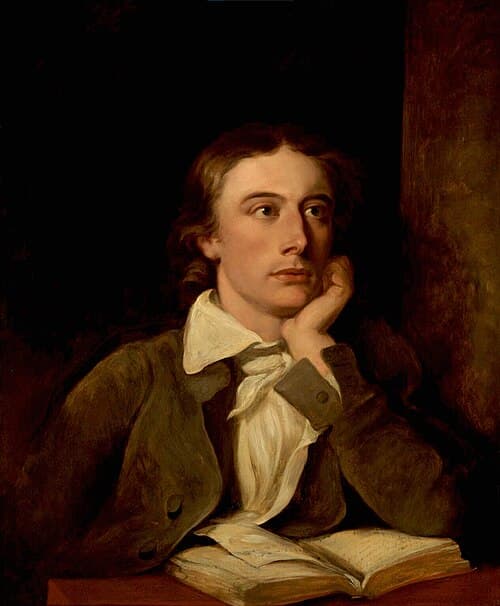
Born on 31 October 1795 in Moorgate, London, the eldest son of Thomas Keats, a livery-stable manager, and Frances Jennings, John Keats lost his father in a riding accident in 1804 and his mother to tuberculosis in 1810. He was apprenticed to an apothecary-surgeon at fourteen, earned his apothecary’s license in 1816, and briefly practiced medicine before abandoning it entirely for poetry , a decision that bewildered his guardian, who controlled the modest family inheritance Keats never fully received. His first volume, Poems (1817), attracted little notice; Endymion (1818) drew savage reviews, with Blackwood’s Magazine dismissing him as a member of the “Cockney School of Poetry.” None of this discouraged him. In an astonishing burst of creative energy between January and September 1819, Keats composed virtually all the work on which his reputation rests: “Ode to a Nightingale,” “Ode on a Grecian Urn,” “Ode to Autumn,” “La Belle Dame sans Merci,” “The Eve of St. Agnes,” and the unfinished Hyperion poems. His letters, written during these same months, constitute one of the richest bodies of literary criticism by any English poet, introducing the concepts of “Negative Capability” and the “chameleon poet.” In February 1820, he coughed blood onto his pillow and recognized it immediately , having trained as a surgeon, he called it his “death warrant.” He sailed to Italy in September 1820 with the painter Joseph Severn. He died in a small room beside the Spanish Steps in Rome on 23 February 1821, at the age of twenty-five. His self-composed epitaph read: “Here lies One whose Name was writ in Water.”
On the night of 3 February 1820, Keats called for a candle to examine a fleck of blood on his pillow. He studied it, then told Charles Brown, calmly, that he recognized the colour: arterial blood. Trained as an apothecary, he knew exactly what it meant. 'That drop of blood is my death warrant,' he said. 'I must die.'
Severn, lift me up. I am dying. I shall die easy. Don't be frightened, be firm, and thank God it has come!
The first button needs the app on this device; the second gets it there.
In the canon, 20 works
- On First Looking into Chapman's Homer1816
- On Seeing the Elgin Marbles1817
- Endymion1818
- When I Have Fears That I May Cease to Be1818
- Ode on a Grecian Urn1819
- Ode to a Nightingale1819
- La Belle Dame sans Merci1819
- Ode to Psyche1819
- Ode on Melancholy1819
- Ode on Indolence1819
- The Fall of Hyperion1819
- Bright Star1819