
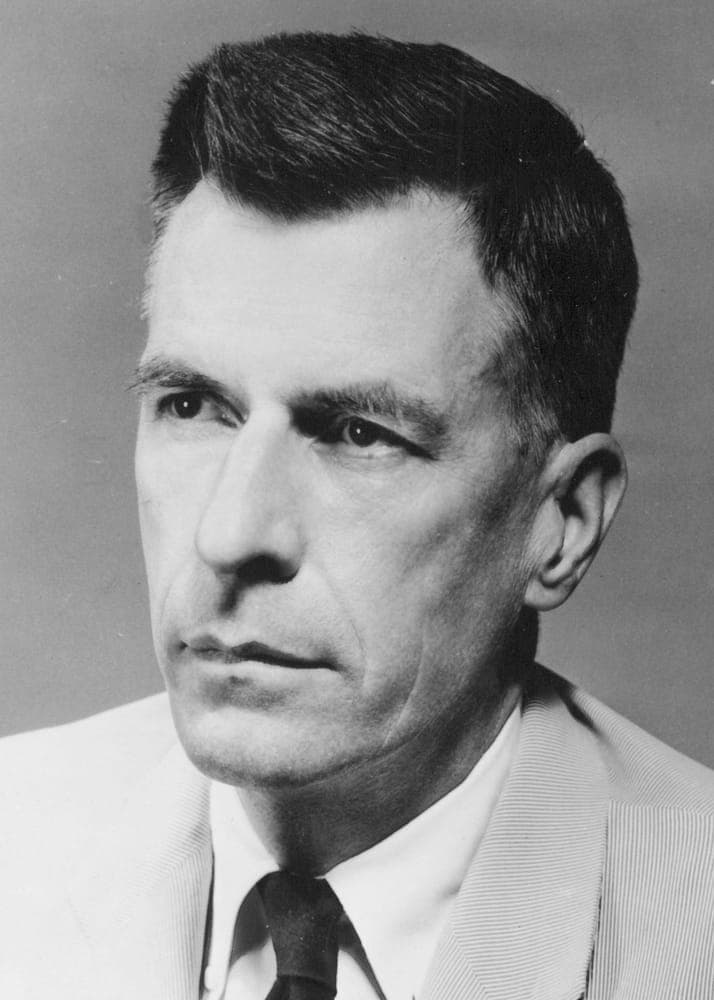
Author
John Kenneth Galbraith
- Lived
- Lived 1908 to 2006
- From
- From Canadian-American
- Born in
- Born in Iona Station, Ontario, Canada
Born on October 15, 1908, on a farm at Iona Station in Dunwich Township, Ontario, to Archibald Galbraith, a Scots-Canadian farmer and local Liberal Party official, and Sarah Catherine Kendall, a community activist, John Kenneth Galbraith grew to six feet nine, the tallest Canadian in any room he ever entered. His mother died when he was fourteen. He took a degree in animal husbandry at the Ontario Agricultural College in 1931, then a doctorate in agricultural economics at Berkeley in 1934, paid for by a sixty-dollar-a-month Giannini scholarship. He joined Harvard the same year, took American citizenship in 1937, and spent most of the next half-century there. During the war he ran price stabilisation at the Office of Price Administration in Washington, a job that gave him a permanent suspicion of the corporate sector and the conviction that organised power, not the market, set American prices. He served Roosevelt, Truman, Kennedy, and Johnson; Kennedy, his Harvard student in the 1940s, made him ambassador to India from 1961 to 1963, and Galbraith advised him daily by cable, including in the Cuban missile crisis. The Affluent Society (1958) coined conventional wisdom and private affluence amid public squalor, arguing that postwar America had outgrown the economics of scarcity. The New Industrial State (1967) and Economics and the Public Purpose (1973) completed the trilogy. He wrote forty-eight books and a thousand essays, was twice president of the American Economic Association, edited Fortune magazine for five years, and learned during Watergate that Nixon had put him on the enemies list. He died of natural causes in Cambridge, Massachusetts, on April 29, 2006, at ninety-seven, after a sixty-eight-year marriage to Catherine Atwater. He is buried in Middletown, Connecticut.
During the Second World War, Roosevelt put the thirty-something economist in charge of controlling nearly every price in the American economy at the Office of Price Administration. Business lobbyists hounded him out in 1943 as a communist sympathizer. Henry Luce, the conservative publisher of Time and Fortune, hired him within weeks.
The first button needs the app on this device; the second gets it there.
In the canon
- The Affluent Society1958