
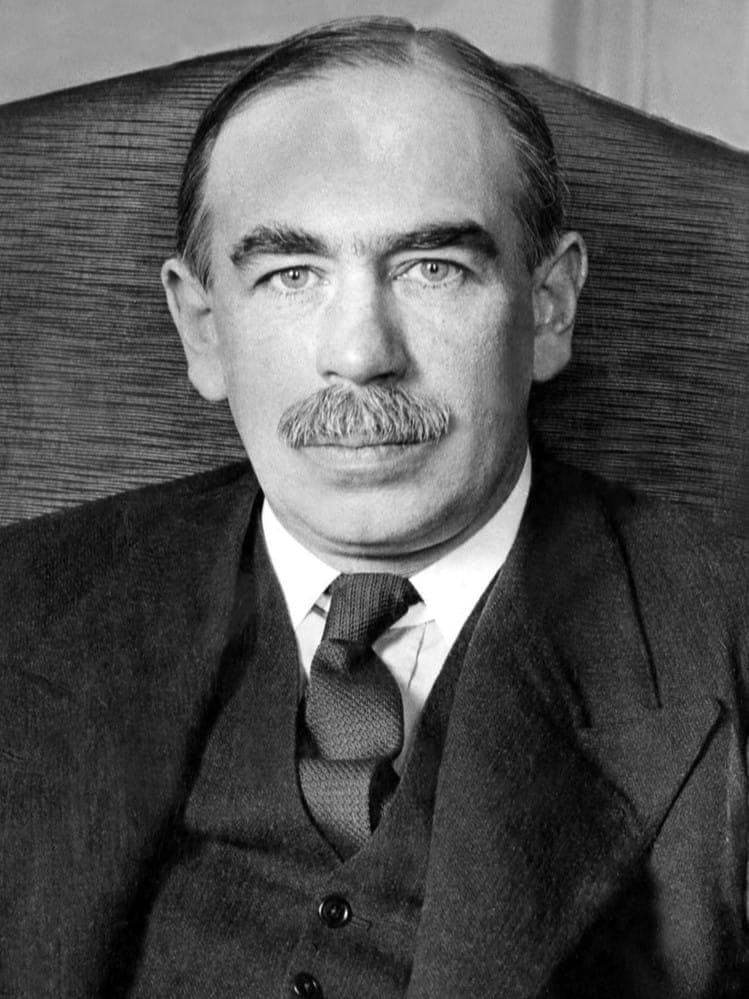
Author
John Maynard Keynes
- Lived
- Lived 1883 to 1946
- From
- From British
- Born in
- Born in Cambridge, England
Born John Maynard Keynes on June 5, 1883, in Cambridge, the eldest child of John Neville Keynes, a Cambridge lecturer in moral sciences, and Florence Ada Keynes, a social reformer who later became the city's second female mayor, he was schooled at Eton, where he was a contemporary of Aldous Huxley, and at King's College, Cambridge, where he read mathematics, took a first in 1904, and was elected to the Cambridge Apostles. He passed into the India Office in 1906, returned to King's as a fellow in 1909, and made his name during the Versailles peace conference of 1919, which he attended as the Treasury's senior representative and from which he resigned in protest at what he considered a vindictive settlement. The Economic Consequences of the Peace (1919) sold a hundred thousand copies and made him an international figure. He married the Ballets Russes dancer Lydia Lopokova in 1925, was a long-standing member of the Bloomsbury Group, served on the boards of the National Mutual and the Bank of England, and during the 1930s formulated the theory that gave macroeconomics its modern shape. The General Theory of Employment, Interest and Money (1936) argued that demand, not supply, determined output, that inadequate aggregate demand could lock economies into prolonged unemployment, and that governments must intervene with fiscal stimulus. By 1945 most Western governments were applying his framework. He led the British delegation at Bretton Woods in 1944, helping to design the IMF and World Bank, and was raised to the peerage in 1942. He died of a heart attack at Tilton, his Sussex home, on April 21, 1946, at the age of sixty-two, exhausted by negotiating Britain's postwar American loan.
As King's College's first bursar from 1924, Keynes ran its investment fund from his own bedroom, spending half an hour most mornings still under the covers, reading company reports and telephoning his brokers before he had even dressed, then lecturing that afternoon on why markets could not be trusted to correct themselves.
The first button needs the app on this device; the second gets it there.
In the canon
- The General Theory of Employment, Interest and Money1936