
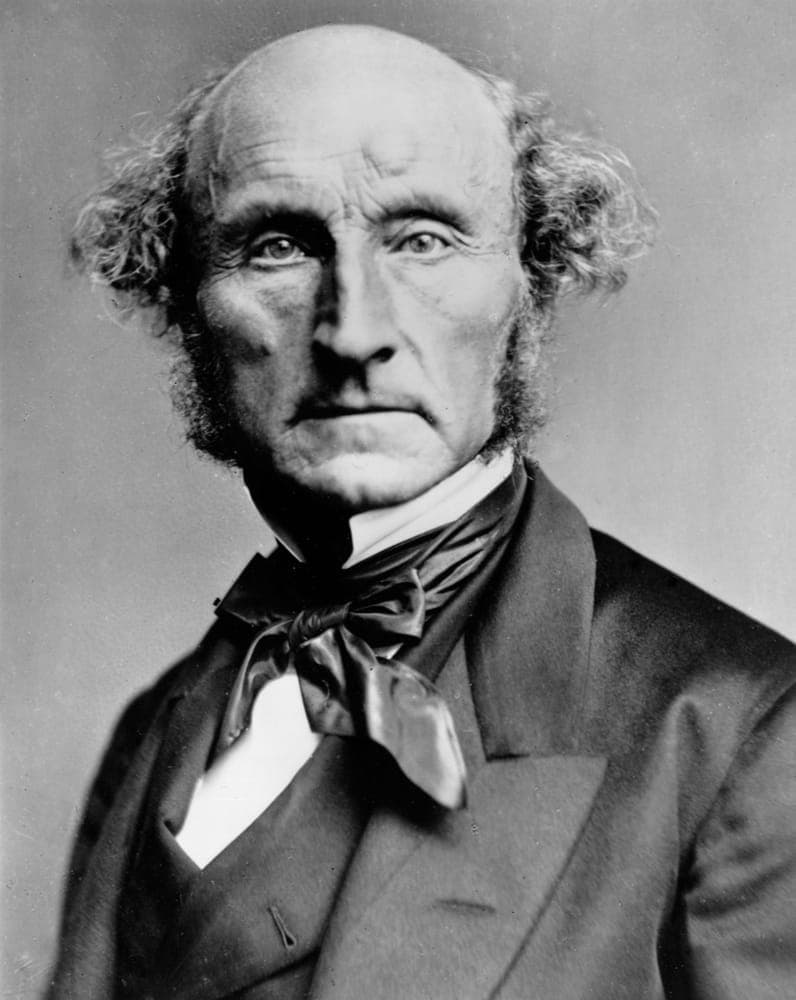
Author
John Stuart Mill
- Lived
- Lived 1806 to 1873
- From
- From English
Born on May 20, 1806, in Pentonville, London, John Stuart Mill was the eldest son of the Scottish historian and philosopher James Mill, who subjected the boy to an experiment in education that became famous. He learned Greek at three, Latin at eight, and had read Plato, Herodotus, and the whole of Gibbon before most children begin school. At twenty he suffered a mental breakdown, a crisis he later credited Wordsworth's poetry with helping him survive. For thirty-five years he worked for the East India Company, rising to chief examiner, while writing the books that made him the foremost liberal thinker of the Victorian age. A System of Logic (1843) and Principles of Political Economy (1848) established his reputation, but his lasting fame rests on On Liberty (1859), a defense of individual freedom against the tyranny of the majority that he wrote in close collaboration with Harriet Taylor, whom he married in 1851 after a long attachment. Her death in 1858 shadowed the rest of his life. He went on to publish Utilitarianism (1863) and The Subjection of Women (1869), an early argument for sexual equality. Elected to Parliament for Westminster in 1865, he became the first member to propose votes for women, moving an amendment to the 1867 Reform Bill. He served a single term. His Autobiography appeared in 1873, the year of his death. He died on May 7, 1873, in Avignon, France, at the age of sixty-six, and was buried there beside Harriet, in the cemetery where he had kept a house to be near her grave.
The first button needs the app on this device; the second gets it there.
In the canon
- On Liberty1859
- Utilitarianism1863
- The Autobiography Of John Stuart Mill1873