
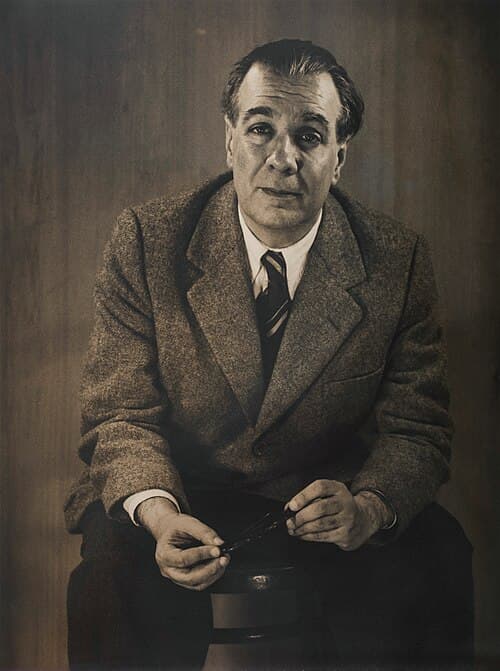
Author
Jorge Luis Borges
- Lived
- Lived 1899 to 1986
- From
- From Argentine
- Born in
- Born in Buenos Aires, Argentina
Born on 24 August 1899 in Buenos Aires, in the home of his maternal grandparents on Calle Tucumán, Jorge Francisco Isidoro Luis Borges grew up in a household where English and Spanish were spoken interchangeably , his paternal grandmother was English, and he read Don Quixote first in English translation before discovering, with some surprise, that the original was in Spanish. His father, Jorge Guillermo Borges, was a lawyer with literary aspirations and a library of unlimited English books; his progressive blindness, inherited by his son, haunted both their lives. The family moved to Geneva in 1914, where Borges attended the Collège de Genève and taught himself German in order to read Schopenhauer. After years in Spain, where he encountered the ultraist poets, he returned to Buenos Aires in 1921 and began publishing essays and poetry. But it was the short stories , gathered in Ficciones (1944) and El Aleph (1949) , that remade the possibilities of narrative fiction. “Tlön, Uqbar, Orbis Tertius,” “Pierre Menard, Author of the Quixote,” “The Library of Babel,” “The Garden of Forking Paths” , these were stories that treated metaphysics as adventure and philosophy as plot. He worked as a municipal librarian for nine years under Perón’s government, which demoted him from his post to poultry inspector in a public market. By 1955, completely blind, he was appointed director of the Argentine National Library , a coincidence he found bitterly ironic: “God, with splendid irony, granted me at once 800,000 books and darkness.” He shared the first International Publishers’ Formentor Prize with Samuel Beckett in 1961, never won the Nobel, and died in Geneva on 14 June 1986, having returned to the city of his adolescence to die.
On Christmas Eve 1938, hurrying up a dark stairwell, Borges struck his head on an unlatched casement window. The wound turned septic; feverish and hallucinating, he lay near death for weeks. When he recovered, unsure whether his mind still worked, he tested it by writing something wholly new: Pierre Menard, Author of the Quixote.
The first button needs the app on this device; the second gets it there.
In the canon, 19 works
- Streetcorner Man1933
- A Universal History of Iniquity1935
- Pierre Menard, Author of the Quixote1939
- Tlön, Uqbar, Orbis Tertius1940
- The Circular Ruins1940
- The Library of Babel1941
- The Garden of Forking Paths1941
- The Lottery in Babylon1941
- Death and the Compass1942
- Funes the Memorious1942
- The Shape of the Sword1942
- Theme of the Traitor and the Hero1944