
Author
Juana Inés de la Cruz
- Lived
- Lived 1648 to 1695
- From
- From Mexican
- Born in
- Born in San Miguel Nepantla, New Spain
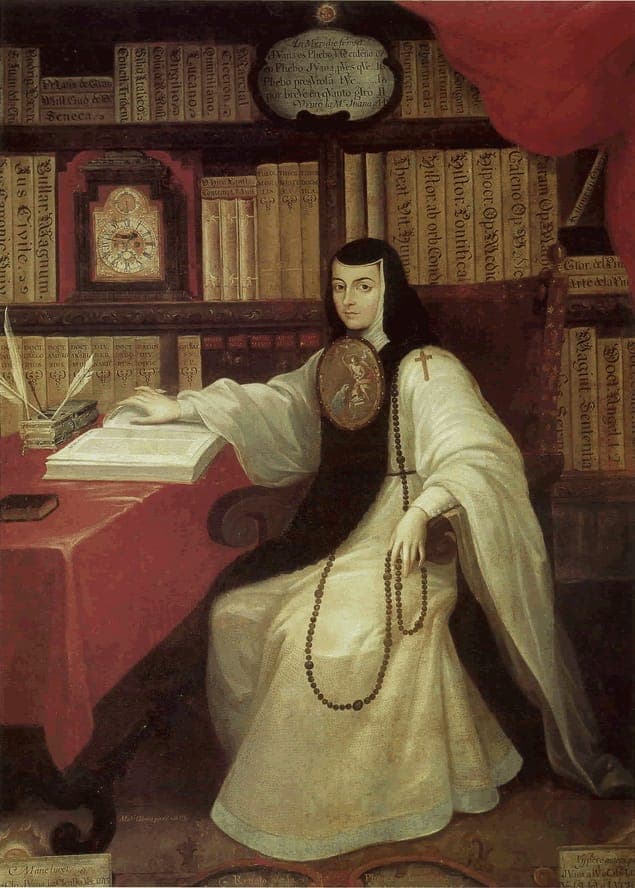
Born in 1648 in San Miguel Nepantla, a village in the shadow of the volcanoes outside Mexico City, Juana Ramírez de Asbaje was the illegitimate daughter of a Spanish captain who played little part in her life and a criolla mother who could not read. Raised on her grandfather's hacienda, she taught herself to read at three from his private library, mastered Latin in a few months of borrowed lessons, and by eight had composed a poem for a church feast. At sixteen she begged her mother's permission to disguise herself as a boy so she could attend the university in Mexico City; refused, she went instead to the viceregal court, where in 1668 the viceroy summoned forty scholars to test whether her learning was genuine and she answered every question unprepared. She entered a Carmelite convent that same year, found its rule too severe, and in 1669 took her final vows as a Hieronymite nun at the Convent of Santa Paula, choosing the cloister, she said, because it left her free to study. There she assembled a library of some four thousand books alongside scientific and musical instruments, wrote court entertainments, devotional dramas, and the redondillas of Hombres necios que acusáis, and composed Primero Sueño, a philosophical poem on the soul's hunger for knowledge that she called the only piece she ever wrote purely for herself. In 1690 a bishop published, without her consent, her critique of a Portuguese Jesuit's sermon, then rebuked her in print for neglecting religious study; her Respuesta a Sor Filotea (1691) answered him with a defense of women's right to learn that has outlived the controversy that provoked it. Under continuing pressure from her superiors, she sold her books and instruments in 1694 and turned to penance. She died in Mexico City on April 17, 1695, at forty-six, after falling ill while nursing her fellow nuns through an epidemic that swept the convent.
In 1668, the viceroy summoned forty theologians, philosophers, and mathematicians to test whether a seventeen-year-old girl's learning was genuine. Juana answered every question unprepared, in Latin and Spanish, until the room fell silent. The viceroy later said she had turned aside their questions the way a royal galleon fends off a few canoes.
The first button needs the app on this device; the second gets it there.
In the canon
- Hombres necios que acusáis (Redondillas / "You Foolish Men")1689