
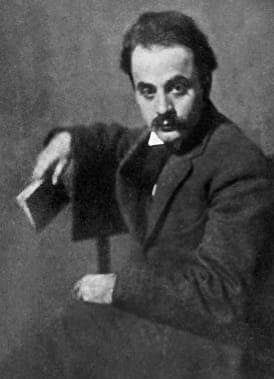
Author
Kahlil Gibran
- Lived
- Lived 1883 to 1931
- From
- From Lebanese-American
- Born in
- Born in Bsharri, Lebanon
Born Jubrān Khalīl Jubrān on January 6, 1883, in the village of Bsharri in Mount Lebanon under Ottoman rule, the son of a tax collector imprisoned for embezzlement and Kamila Rahmeh, a priest's daughter, Kahlil Gibran spent his earliest years in poverty. In June 1895 his mother left her husband and sailed for Boston with her four children, settling in the second-largest Syrian community in the United States. A teacher at his immigrant school noticed his drawings and brought him to the photographer and publisher F. Holland Day, who introduced the boy to Boston's avant-garde. Sent back to Beirut at fifteen to enroll at the Collège de la Sagesse, he returned to Boston in 1902 only to lose his sister, his half-brother, and his mother to tuberculosis within a year. With the support of his patron and lifelong correspondent Mary Haskell, Gibran studied painting in Paris from 1908 to 1910, returning to America to settle in a small Greenwich Village studio he called the Hermitage. His first English book, The Madman, appeared in 1918. The Prophet, published by Alfred A. Knopf in 1923, is the address of a wise man named Almustafa to the people of Orphalese on the day he is to leave them by ship, twenty-six prose poems on love, marriage, work, children, joy and sorrow. It became one of the best-selling books of the twentieth century, translated into more than a hundred languages. He never returned to Lebanon. He died of cirrhosis and tuberculosis on April 10, 1931, in New York, at the age of forty-eight, having bequeathed all future royalties from his books to his birthplace of Bsharri.
On the night of 11 November 1904, fire gutted the Harcourt Studios on Irvington Street in Boston. Gibran's entire portfolio of drawings and paintings, kept in the studio of his patron F. Holland Day, burned with it. Three days later he wrote to the poet Josephine Peabody that "the years of Love's labor are lost."
The first button needs the app on this device; the second gets it there.
In the canon
- The Prophet1923