
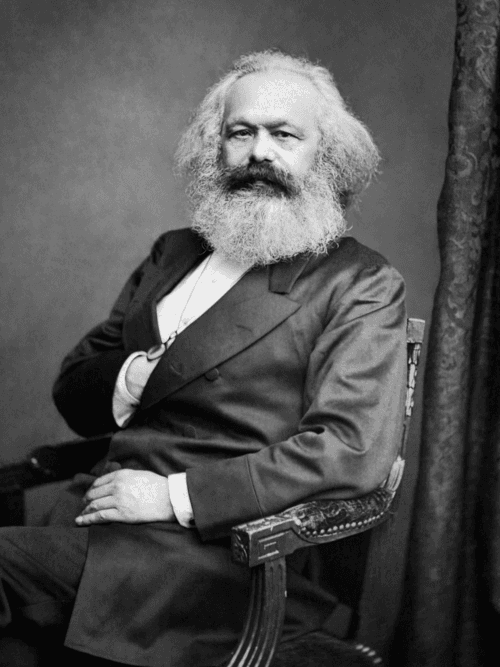
Author
Karl Marx
- Lived
- Lived 1818 to 1883
- From
- From German
- Born in
- Born in Trier, Prussia
Born on 5 May 1818 in Trier, in the Prussian Rhineland, the third of nine children of Heinrich Marx, a prosperous lawyer of Jewish descent who had converted to Lutheranism to preserve his career, and Henrietta Pressburg, Karl Marx grew up in a household shaped by Enlightenment rationalism and social ambition. He studied law at the University of Bonn, where he spent more time drinking and dueling than studying, before transferring to the University of Berlin, where Hegel’s philosophy seized him completely. He received his doctorate from the University of Jena in 1841 with a dissertation on the atomism of Democritus and Epicurus. Barred from an academic career by the Prussian government’s hostility to Young Hegelians, he turned to journalism, editing the Rheinische Zeitung until it was suppressed in 1843. In Paris he wrote the Economic and Philosophic Manuscripts of 1844 and met Friedrich Engels, the son of a textile manufacturer, who became his lifelong collaborator and financial benefactor. Expelled from France and then Belgium, Marx and Engels published The Communist Manifesto (1848), a pamphlet of extraordinary rhetorical force that declared all history the history of class struggle. After the failed revolutions of 1848, Marx settled permanently in London, where he spent decades in the reading room of the British Museum researching Das Kapital (1867), the first volume of his monumental critique of political economy. He lived in chronic poverty, dependent on Engels’s generosity; three of his children died in infancy, largely from the squalid conditions of their Soho lodgings. The second and third volumes of Das Kapital were assembled and published posthumously by Engels. Marx died stateless on 14 March 1883 in London and was buried in Highgate Cemetery, where his tombstone bears the inscription: “Workers of all lands, unite.”
In April 1852 the Marxes' baby daughter Franziska died in their two crowded rooms on Dean Street, Soho, and there was no money for a coffin. Jenny Marx later wrote that their German friends could not help, so she went to a French emigre living nearby. He gave her two pounds at once, and the coffin was paid for.
The first button needs the app on this device; the second gets it there.
In the canon
- The 18th Brumaire of Louis Bonaparte1852
- The Eighteenth Brumaire of Louis Bonaparte1852
- Das Kapital1867
- Das Kapital, Vol. I1867
- Das Kapital, Vol. II1885
- Economic and Philosophic Manuscripts of 18441927
- The German Ideology1932
- Grundrisse1939