
Author
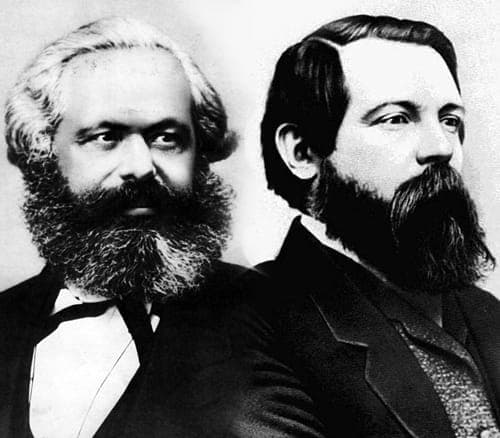
Karl Marx & Friedrich Engels
- Lived
- Lived 1818 to 1895
- From
- From German
- Born in
- Born in Trier and Barmen, Prussia
Karl Marx was born on 5 May 1818 in Trier, in the Prussian Rhineland, the son of a lawyer; Friedrich Engels was born on 28 November 1820 in Barmen, a textile town in the same province, the eldest son of a wealthy cotton manufacturer. They reached the same conclusions from opposite directions: Marx through Hegel's philosophy at the University of Berlin and radical journalism at the Rheinische Zeitung, Engels through the slums of Manchester, where he had been sent to learn the family trade and instead wrote The Condition of the Working Class in England (1845). Their real meeting came in August 1844, ten days of conversation at the Café de la Régence in Paris that revealed, as Engels put it, complete agreement in all theoretical fields. Commissioned by the Communist League in 1847 to write its programme, they produced The Communist Manifesto, published in London in February 1848, days before revolution swept the continent. When the risings failed, both settled in England: Marx in London, researching Das Kapital across long decades in the British Museum reading room while his family lived in poverty, Engels in Manchester, working at the cotton firm he disliked so that his friend could keep writing. Engels supported Marx with money, with research, and with a quarter of the newspaper columns published under Marx's name; after Marx died in March 1883, he gave twelve years of labour to turning his chaotic manuscripts into the second and third volumes of Das Kapital. Engels died of throat cancer in London on 5 August 1895, and his ashes were scattered at sea off Beachy Head. Between them they built the most consequential intellectual partnership of the nineteenth century, and a body of ideas that reshaped the politics of the twentieth.
In August 1844, Engels stopped in Paris on his way home to Germany and called on Marx at the Café de la Régence, an old haunt of Voltaire and Diderot. Ten days of conversation followed. 'Our complete agreement in all theoretical fields became evident,' Engels later wrote, 'and our joint work dates from that time.'
The first button needs the app on this device; the second gets it there.
In the canon
- The Communist Manifesto1848
- The Manifesto of the Communist Party1848