
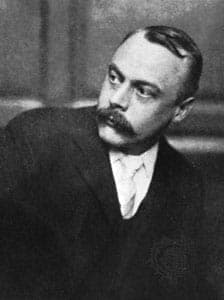
Author
Kenneth Grahame
- Lived
- Lived 1859 to 1932
- From
- From Scottish
- Born in
- Born in Edinburgh, Scotland
Born Kenneth Grahame on March 8, 1859, at 32 Castle Street in Edinburgh, the son of James Cunningham Grahame, an advocate, and Elizabeth Ingles, he lost his mother to scarlet fever in 1864, when he was five, and contracted the disease himself badly enough that it left him vulnerable to chest infections for life. His father, a brilliant but alcoholic man, gave up the children to their maternal grandmother in Cookham Dean, Berkshire, and went to live in France. He never saw them again. The grandmother's house at The Mount sat near the Thames at Cookham, and the river became Grahame's first and lasting landscape. He went to St Edward's School in Oxford, was head boy and captain of rugby, and dreamed of Oxford itself, but his guardian uncle refused to finance the university and put him into a clerkship at the Bank of England in 1879. He rose, slowly and reluctantly, to become Secretary of the Bank by 1898, the third-highest position there. He wrote in his evenings, publishing essays and stories in the National Observer and the Yellow Book. Pagan Papers (1893), The Golden Age (1895), and Dream Days (1898), idylls of country childhood, made him a small literary name. In 1899 he married Elspeth Thomson, a difficult match; their only child Alastair was born blind in one eye in 1900. The bedtime stories he invented for the boy about a Mole, a Rat, a Badger, and a vainglorious Toad became The Wind in the Willows (1908), which Theodore Roosevelt championed in America after British critics found it strange. Alastair died on a railway line at Oxford in 1920, aged twenty. Grahame never recovered. He died at Pangbourne, Berkshire, on July 6, 1932, at seventy-three.
On 24 November 1903, a stranger walked into the Bank of England and held out a rolled manuscript, tied at one end with a white ribbon and at the other with black, asking Grahame to choose. He chose black. The man's hands now free, he drew a revolver and fired three shots. Every one missed.
The first button needs the app on this device; the second gets it there.
In the canon
- The Wind in the Willows1908