
Author
Laozi
- Lived
- Lived 600 BCE to 500 BCE
- From
- From Chinese
- Born in
- Born in Ku County, state of Chu
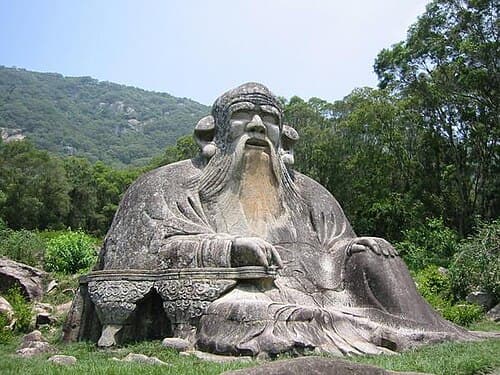
The figure known as Laozi, literally "Old Master", is said to have been born Li Er in the sixth century BC in the state of Chu, during China's Spring and Autumn period, though modern scholarship regards most details of his life as later inventions layered over an archaic anonymity. Traditional accounts place him as the royal archivist for the Zhou court at Wangcheng, near modern Luoyang, where he is said to have met and impressed the younger Confucius. The Tao Te Ching (Daodejing), the foundational text of Taoism attributed to him, may have been composed over centuries by multiple hands, but its eighty-one brief chapters, barely five thousand characters in Chinese, became one of the most translated works in human history, second only to the Bible. The text counsels wu wei, or effortless action, and articulates a vision of the Tao as the nameless source of all things: "The Tao that can be told is not the eternal Tao." Legend holds that, disillusioned with the moral decay of the Zhou dynasty, Laozi departed westward through the Hangu Pass, where a border guard named Yin Xi persuaded him to write down his teachings before vanishing into the wilderness forever. The Tao Te Ching became the cornerstone of Taoist philosophy and religion, shaping Chinese thought for over two millennia. Certain Taoist sects came to worship Laozi as Laojun, one of the Three Pure Ones of the Taoist pantheon. The Tang dynasty (618-907) claimed him as an ancestor, and he remains honored in modern China as the progenitor of the surname Li. Whether he was one man, many men, or no man at all, the text that bears his name endures, a paradox befitting a philosophy built on paradox.
In Sima Qian's account, the old archivist despaired of the failing Zhou court and rode west to leave the world. At the frontier pass the gatekeeper Yin Xi would not let him through until he wrote his wisdom down. He left five thousand characters in two parts, the Tao Te Ching, and was never seen again.
The first button needs the app on this device; the second gets it there.
In the canon
- The Tao Te Ching600 BCE