
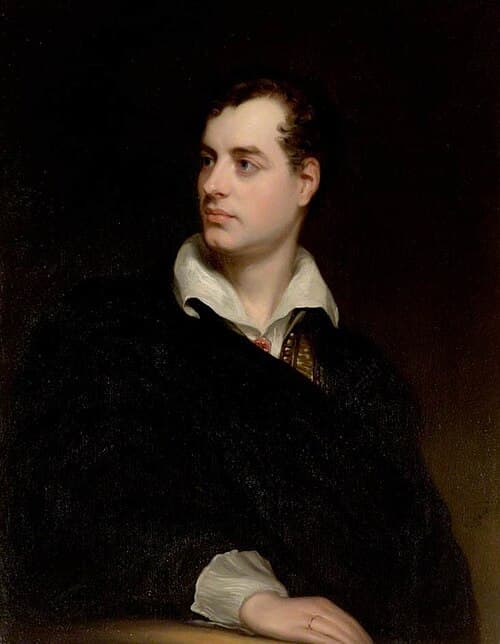
Author
Lord Byron
- Lived
- Lived 1788 to 1824
- From
- From English
- Born in
- Born in London, England
Born George Gordon Byron on January 22, 1788, at 16 Holles Street, London, the son of Captain "Mad Jack" Byron and Catherine Gordon, a Scottish heiress whose fortune his father quickly squandered. Byron was born with a clubfoot, likely a form of talipes equinovarus, that caused him anguish and self-consciousness throughout his life, despite his later fame for physical beauty. His father fled to France to escape creditors and died when George was three. In 1798, at age ten, the boy unexpectedly inherited the title of 6th Baron Byron and the ruined estate of Newstead Abbey in Nottinghamshire, a former Augustinian priory granted to the family by Henry VIII. He was educated at Harrow and Trinity College, Cambridge, where he kept a pet bear in his rooms because dogs were forbidden. His first major poem, Childe Harold's Pilgrimage (1812), published after a grand tour of the Mediterranean, made him the most famous poet in England overnight, "I awoke one morning and found myself famous," he reportedly said. Scandals accumulated: an affair with Lady Caroline Lamb, persistent rumors of incest with his half-sister Augusta Leigh, a disastrous marriage to Annabella Milbanke that lasted barely a year. In 1816, hounded by debt and disgrace, he left England forever. He lived in Italy for seven years, writing his masterpiece Don Juan (1819-1824), a sprawling comic epic in ottava rima. In 1823, he sailed for Greece to join the war of independence against the Ottoman Empire. He died of fever on April 19, 1824, in Missolonghi, aged thirty-six. Greeks revere him as a national hero.
On 3 May 1810, Byron swam the Hellespont, the mile-wide strait dividing Europe from Asia, in imitation of the drowned lover Leander. The crossing took over an hour against a bitter current. He boasted of it ever after, prouder of the swim, he wrote, than of any glory his poetry could bring.
I must sleep now.
The first button needs the app on this device; the second gets it there.
In the canon, 13 works
- Childe Harold's Pilgrimage1812
- She Walks in Beauty1814
- The Destruction of Sennacherib1815
- The Prisoner of Chillon1816
- When We Two Parted1816
- Darkness1816
- Childe Harold's Pilgrimage: Canto III1816
- Stanzas for Music1816
- Manfred1817
- So, we'll go no more a roving1817
- Beppo1818
- Cain1821