
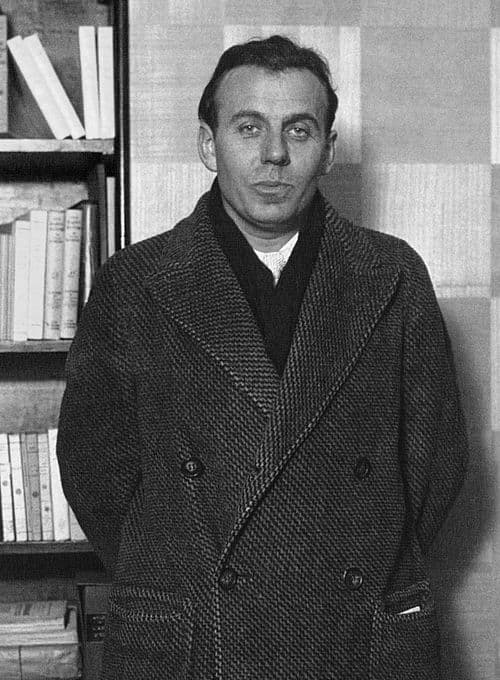
Author
Louis-Ferdinand Céline
- Lived
- Lived 1894 to 1961
- From
- From French
- Born in
- Born in Courbevoie, France
Born Louis Ferdinand Auguste Destouches on May 27, 1894, in Courbevoie, a suburb northwest of Paris, the son of an insurance clerk and a lace-maker, Celine grew up in modest circumstances in the covered passages of central Paris, where his mother ran a small shop. He enlisted in the army at seventeen, served with the 12th Cuirassiers, and in October 1914, during the early months of World War I, was gravely wounded in the arm and head near Ypres while volunteering for a dangerous mission, earning the Medaille militaire. The injury left him with chronic headaches and tinnitus for life. After the war, he studied medicine, earning his degree in 1924, and practiced as a doctor in the Parisian working-class suburb of Clichy and later for the League of Nations in Africa. His first novel, Journey to the End of the Night (1932), written under the pen name Celine, his grandmother's first name, was a volcanic outpouring of disgust, black comedy, and hallucinatory prose that followed its antihero Ferdinand Bardamu through the trenches, colonial Africa, the Ford assembly lines of Detroit, and the Parisian slums. It won the Prix Renaudot and divided critics violently. Death on the Installment Plan (1936) continued his assault on bourgeois pieties. Maurice Nadeau wrote: "What Joyce did for the English language, Celine achieved effortlessly and on a vast scale." Then came the catastrophe: beginning in 1937, Celine published a series of virulently antisemitic pamphlets. During the German occupation he continued to espouse antisemitism, and in 1944 he fled to Germany, then Denmark, where he lived in exile. Convicted of collaboration in 1950, pardoned in 1951, he returned to France and practiced medicine in Meudon until his death on July 1, 1961.
In October 1914, near Ypres, the twenty-year-old cavalryman Destouches volunteered to carry a message through heavy German fire when others hung back. A bullet tore into his right arm; the surgeons weighed amputation. He received the Médaille militaire, appeared as a decorated hero on a magazine cover, and felt the wound for the rest of his life.
The first button needs the app on this device; the second gets it there.
In the canon
- Journey to the End of the Night1932
- Death on Credit1936
- Death on the Installment Plan1936
- Guignol's Band1944
- Castle to Castle1957
- North1960