
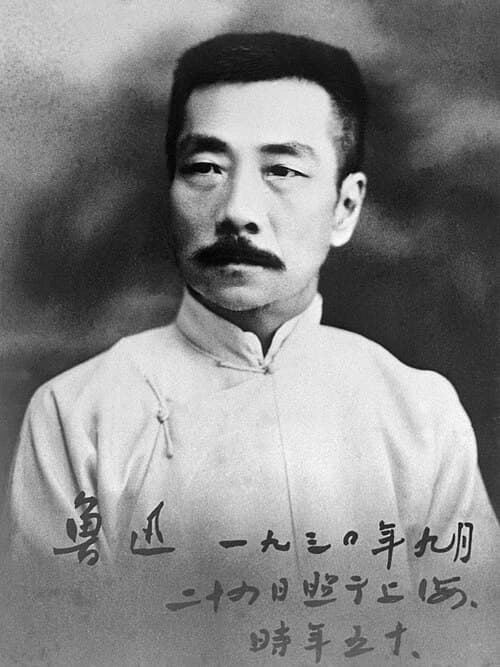
Author
Lu Xun
- Lived
- Lived 1881 to 1936
- From
- From Chinese
- Born in
- Born in Shaoxing, China
Born Zhou Shuren on September 25, 1881, in Shaoxing, Zhejiang province, into a declining family of landlords and scholar-officials, Lu Xun would become the most important figure in modern Chinese literature. His grandfather, a jinshi degree holder who had served as a government official, was imprisoned for attempted bribery when Lu Xun was a boy, plunging the family into poverty and shame, an experience that gave the young man a bitter understanding of social hypocrisy. He initially studied mining and then medicine at Tohoku University in Japan, but a pivotal moment occurred when he saw a lantern slide of a Chinese man about to be executed by the Japanese during the Russo-Japanese War while Chinese onlookers watched with blank indifference. He decided that curing the nation's spiritual sickness mattered more than treating its bodies, and abandoned medicine for literature. Returning to China, he taught and worked at the Ministry of Education before publishing "Diary of a Madman" (1918), the first major work of fiction in vernacular Chinese, whose narrator discovers that Chinese history is nothing but a record of cannibalism. "The True Story of Ah Q" (1921-1922), a devastating satire of national character, and the story collection Call to Arms (1923) cemented his reputation. His essays, mordant, fearless, and prolific, attacked feudalism, Confucian hypocrisy, and political tyranny with equal ferocity. In the 1930s, he became the nominal leader of the League of Left-Wing Writers in Shanghai, though his relationship with the Communist Party remained complicated. He died of tuberculosis on October 19, 1936, in Shanghai, at fifty-five. Mao Zedong later canonized him as a revolutionary saint, an irony Lu Xun, who despised all orthodoxies, would likely have found insufferable.
In 1917, an old friend visited Lu Xun and urged him to write for a new magazine. Lu Xun answered with an image: an iron house with no windows, packed with sleeping people who would suffocate before waking. If even a few woke, his friend said, you could not call the house hopeless. Lu Xun began to write.
Do not accept a penny from anyone for my funeral, old friends excepted. Hurry up and put me in my coffin and bury me, and have done with it. Do nothing in the way of commemorating me. Forget me, and take care of your own lives.
The first button needs the app on this device; the second gets it there.
In the canon
- A Madman's Diary1918
- The True Story Of Ah Q1922
- The New-Year Sacrifice1924
- From Hundred-Plant Garden to Three-Flavor Study1926
- Forging the Swords1927