
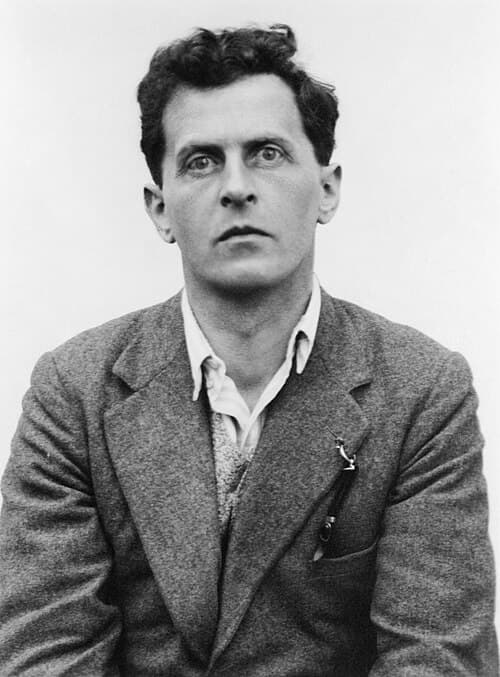
Author
Ludwig Wittgenstein
- Lived
- Lived 1889 to 1951
- From
- From Austrian-British
- Born in
- Born in Vienna, Austria
Born on April 26, 1889, in Vienna, into one of the wealthiest families in Europe, his father Karl was a steel magnate, his mother Leopoldine a patron of the arts, and their home hosted Brahms, Mahler, and Klimt, Ludwig Josef Johann Wittgenstein grew up surrounded by extraordinary privilege and extraordinary suffering. Three of his four older brothers died by suicide. He studied mechanical engineering in Berlin and Manchester before becoming obsessed with the foundations of mathematics and arriving, in 1911, at the door of Bertrand Russell in Cambridge, who judged him a genius. During World War I, he served as an officer on the front line in the Austro-Hungarian army, decorated multiple times for courage, and completed the Tractatus Logico-Philosophicus (1921) in the trenches and in an Italian prisoner-of-war camp. The work, seventy-five numbered propositions ending with "Whereof one cannot speak, thereof one must be silent", claimed to have solved all philosophical problems. Convinced he had nothing more to say, Wittgenstein gave away his entire fortune to his siblings and became, in turn, a village schoolteacher in Austria, a gardener at a monastery, and an architect who designed a minimalist house in Vienna for his sister. He returned to Cambridge in 1929 and spent the rest of his career dismantling his own early work. The Philosophical Investigations (published posthumously in 1953) argued that meaning resides not in logical structure but in the practical use of language, a reversal so radical it constituted a second philosophical revolution. He died of prostate cancer on April 29, 1951, in Cambridge, telling his doctor, "Tell them I've had a wonderful life."
Convinced it was intolerable to teach philosophy while London burned, Wittgenstein took a job in 1941 as a dispensary porter at Guy's Hospital, wheeling medicines to the wards. Few of the staff knew the porter was among the most famous philosophers alive, and he reportedly told patients, quietly, not to take the pills he brought them.
Tell them I've had a wonderful life.
The first button needs the app on this device; the second gets it there.
In the canon
- Tractatus Logico-Philosophicus1921
- Philosophical Investigations1953
- Remarks on the Foundations of Mathematics1956
- The Blue and Brown Books1958
- On Certainty1969
- Culture and Value1977