
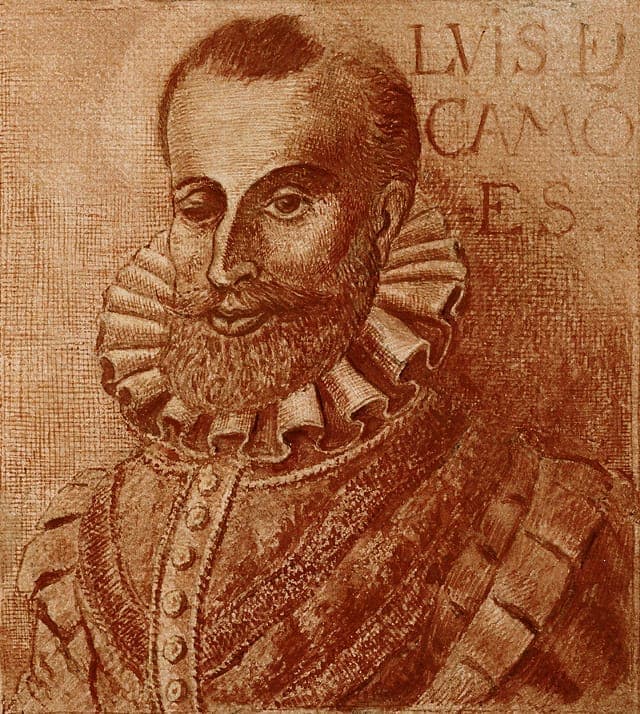
Author
Luís Vaz Camões
- Lived
- Lived 1524 to 1580
- From
- From Portuguese
- Born in
- Born in Lisbon, Portugal
Born around 1524 in Lisbon, the only son of Simão Vaz de Camões, a minor nobleman who served in the Royal Navy, and Ana de Sá e Macedo, Luís Vaz de Camões grew up in straitened gentility, descended on his father's side from a Galician troubadour and on his mother's from the family of Vasco da Gama. He was educated, probably by his uncle Bento, a chancellor of the University of Coimbra and prior of the Monastery of Santa Cruz, and arrived at the court of John III a poor minor nobleman with a sharp tongue and an extravagant gift for verse. After a sword fight in a Corpus Christi procession landed him in prison, he was released in 1553 on condition that he sail for India. He served as a soldier in Goa, in the Red Sea, in the Persian Gulf, and at Macau, where tradition says he composed much of his epic in a cave. Returning to Goa he was shipwrecked at the mouth of the Mekong; legend has him swimming ashore with the manuscript of Os Lusíadas held above his head. He reached Lisbon in 1570 after seventeen years away, missing his right eye from a North African naval battle and very nearly destitute. Os Lusíadas (1572), ten cantos in ottava rima telling the voyage of Vasco da Gama to India and through it the history of Portugal, was published with the support of the young King Sebastian. Three years later Sebastian's death at Alcácer Quibir cost Portugal its independence. Camões, struck by bubonic plague, died on June 10, 1580, in Lisbon. The day of his death is now Portugal's national holiday.
In 1546, having fallen out of favor at court, reportedly over his love for Catarina de Ataíde, a lady of the queen's household, Camões was banished into the Ribatejo countryside, then enlisted for service at Ceuta. Two years later, fighting Moorish forces, a wound took his right eye, marking him for life.
The first button needs the app on this device; the second gets it there.
In the canon
- The Lusiad1572