
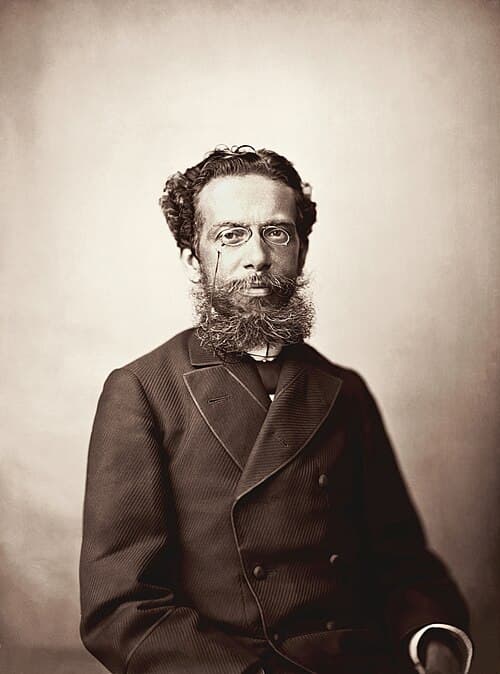
Author
Machado de Assis
- Lived
- Lived 1839 to 1908
- From
- From Brazilian
- Born in
- Born in Rio de Janeiro, Brazil
Born Joaquim Maria Machado de Assis on June 21, 1839, on Morro do Livramento, a hill in Rio de Janeiro, he was the grandson of freed slaves in a country where slavery would not be fully abolished for another forty-nine years. His father, Francisco Jose de Assis, was a mixed-race house painter; his mother, Maria Leopoldina Machado da Camara, was a Portuguese washerwoman from the Azores who died when Joaquim was young. He barely attended school and never went to university, teaching himself French, English, German, and Greek. He began as a typesetter's apprentice at the Imprensa Nacional, then worked his way through journalism and government service, eventually rising to a senior position in the Ministry of Agriculture, Trade and Public Works. He suffered from epilepsy throughout his life, a condition he kept largely hidden, and a severe stammer. His early novels were conventional romantic works, but at age forty-one, something broke open. The Posthumous Memoirs of Bras Cubas (1881), narrated by a dead man who writes his autobiography from beyond the grave, shattered every rule of nineteenth-century fiction with its irony, digressions, and blank chapters. Quincas Borba (1891) and Dom Casmurro (1899), the latter a masterpiece of unreliable narration whose central mystery of adultery remains unresolved, completed a body of work that anticipates Kafka, Borges, and the entire tradition of metafiction by half a century. In 1897, he founded and became the first president of the Brazilian Academy of Letters. His wife, Carolina Augusta Xavier de Novaes, whom he had married in 1869, died in 1904. He never recovered from the loss and died on September 29, 1908, in Rio de Janeiro.
While waiting to receive the French statesman Paul Doumer at Rio's Cais Pharoux docks on 1 September 1907, Machado was seized by one of the epileptic attacks he had hidden from the public since childhood. The city's official photographer, Augusto Malta, caught the moment: the only photograph known to survive of him mid-seizure.
The first button needs the app on this device; the second gets it there.
In the canon
- Posthumous Memoirs of Brás Cubas1881
- The Alienist1882
- Quincas Borba1891
- Dom Casmurro1899
- Esaú and Jacó1904
- Counselor Ayres' Memorial1908