
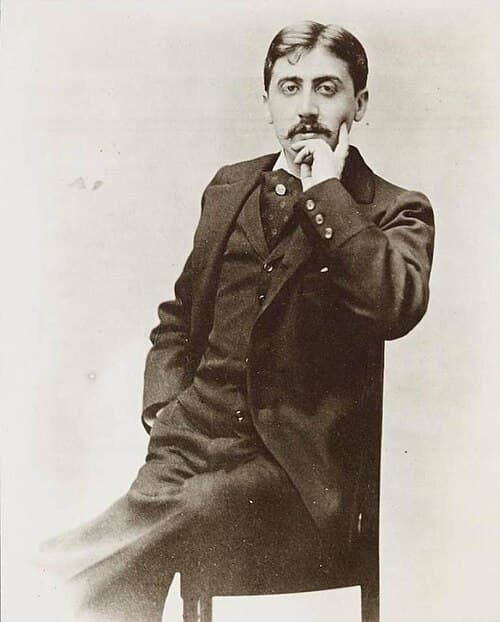
Author
Marcel Proust
- Lived
- Lived 1871 to 1922
- From
- From French
- Born in
- Born in Auteuil, Paris, France
Born Valentin Louis Georges Eugene Marcel Proust on July 10, 1871, in Auteuil, a leafy quarter on the western edge of Paris, the first son of Adrien Proust, a prominent epidemiologist who helped establish international quarantine protocols, and Jeanne Clemence Weil, from a wealthy Jewish family of Alsatian origin. At age nine, Marcel suffered his first severe asthma attack while returning from a walk in the Bois de Boulogne, the disease would govern and constrict his life ever after. He attended the Lycee Condorcet, performed military service at Orleans, studied law and philosophy at the Sorbonne, and moved through the aristocratic salons of the Faubourg Saint-Germain, absorbing the rituals and cruelties of a world he would later anatomize with devastating precision. His early works, the stories of Les Plaisirs et les Jours (1896) and the unfinished novel Jean Santeuil, gave little indication of what was coming. In 1908, he began work on A la recherche du temps perdu (In Search of Lost Time), a novel that would eventually span seven volumes, 1.25 million words, and encompass the entire arc of French society from the Belle Epoque through the First World War. The first volume, Swann's Way (1913), was rejected by several publishers, including Andre Gide at Gallimard, who later called it the "gravest error" of his career, and Proust published it at his own expense. The novel's method, involuntary memory, the madeleine dipped in tea, sentences that unspool for pages, revolutionized fiction. After his mother's death in 1905, Proust retreated to a cork-lined bedroom at 102 Boulevard Haussmann, writing through the night. He died of pneumonia on November 18, 1922, at fifty-one, his final volumes still in proof, his brother Robert overseeing their posthumous publication.
In February 1897, after the critic Jean Lorrain mocked his first book in print and implied a homosexual affair, Proust challenged him to a duel. They met at dawn in the Forest of Meudon, pistols at twenty-five paces. Both men fired. Both missed. Honor, such as it was, stood restored.
The first button needs the app on this device; the second gets it there.
In the canon
- In Search of Lost Time1927
- Jean Santeuil1952