
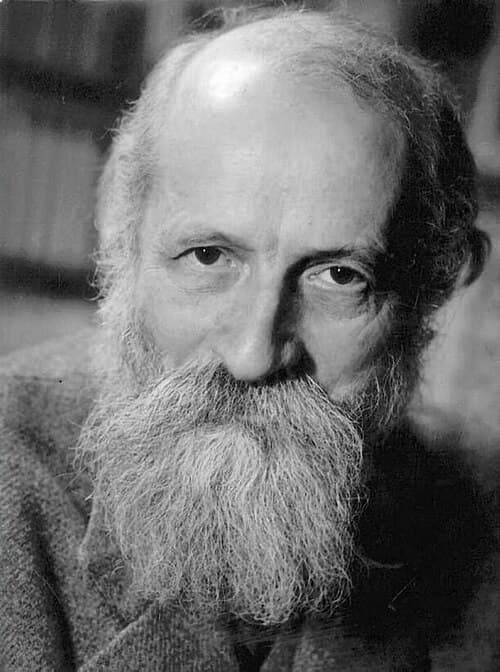
Author
Martin Buber
- Lived
- Lived 1878 to 1965
- From
- From Austrian
- Born in
- Born in Vienna, Austria
Born on February 8, 1878, in Vienna, Martin Buber was raised largely by his grandparents in Lemberg (now Lviv, Ukraine) after his parents’ marriage dissolved when he was three , an early rupture he later described with the word Vergegnung, or “mismeeting,” a term that would haunt his philosophy of human encounter. His grandfather Solomon Buber was a distinguished scholar of Midrash, and the household steeped the boy in Hebrew texts, Yiddish culture, and the intellectual traditions of Galician Jewry. He studied philosophy and art history at the Universities of Vienna, Leipzig, Berlin, and Zurich, where he encountered the Hasidic tales that he would spend decades retelling in German, beginning with The Tales of Rabbi Nachman (1906) and The Legend of the Baal-Shem (1908). In 1923 he published Ich und Du (I and Thou), the slim, incantatory treatise that became one of the most influential philosophical works of the twentieth century, distinguishing between the “I–Thou” relation of genuine dialogue and the “I–It” relation of mere use. From 1925 he collaborated with Franz Rosenzweig on a monumental new German translation of the Hebrew Bible, a project he completed alone after Rosenzweig’s death in 1929. He held a professorship at the University of Frankfurt until 1933, when the Nazi rise to power forced him from academic life. He emigrated to Palestine in 1938 and joined the faculty of the Hebrew University of Jerusalem, where he advocated for Arab-Jewish cooperation and a binational state. He was nominated for the Nobel Prize in Literature ten times and the Nobel Peace Prize seven times, receiving neither. He died in Jerusalem on June 13, 1965, at the age of eighty-seven.
One morning in 1914, warm from hours of religious rapture, Buber received a young man and answered his questions attentively, yet without being wholly present. He never asked what the visitor had truly come for. Later he learned the man had come needing a decision, and was already dead. Buber gave up the ecstatic for the ordinary meeting.
The first button needs the app on this device; the second gets it there.
In the canon
- The Legend of the Baal-Shem1908
- I and Thou1923
- Moses1946
- Two Types of Faith1950
- Eclipse of God1952