
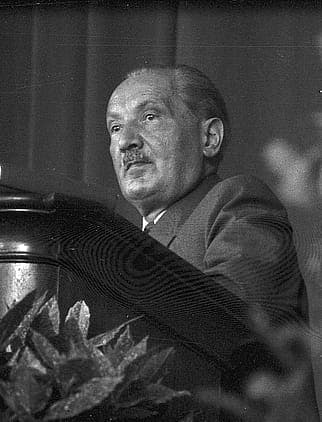
Author
Martin Heidegger
- Lived
- Lived 1889 to 1976
- From
- From German
- Born in
- Born in Meßkirch, Baden, Germany
Born on September 26, 1889, in Meßkirch, a small town in Baden in southwestern Germany, to Johanna Kempf and Friedrich Heidegger, the sexton of the village Catholic church, Martin Heidegger was raised devout and rural. He began training for the priesthood in 1903 and entered a Jesuit seminary in 1909 but was discharged within weeks for heart trouble. He turned instead to theology and then to philosophy at the University of Freiburg, reading Brentano and Husserl, breaking with the church, completing his habilitation on Duns Scotus in 1915. He became Husserl's assistant at Freiburg, then took a professorship at Marburg in 1923, where his lectures drew Hannah Arendt, Hans-Georg Gadamer, Karl Löwith, Leo Strauss, and Hans Jonas. Being and Time appeared in 1927, an unfinished examination of what it means to exist, opening from the puzzle that humans, alone among entities, have a relation to their own being. In 1933 he joined the Nazi Party, was elected rector of Freiburg, gave a notorious inaugural address praising the German revolution, and resigned a year later, his Party membership running until 1945. The denazification commission banned him from teaching until 1949. He never publicly apologised. His postwar work turned to language, technology, and what he called dwelling, often through readings of Hölderlin. He spent his last decades in a small wooden hut at Todtnauberg in the Black Forest, where Paul Celan, a survivor of the camps, visited him in 1967 hoping for a word that never came. He died on May 26, 1976, in Freiburg, aged eighty-six, and was buried in the Meßkirch churchyard.
On 25 July 1967 the poet Paul Celan, a survivor of the camps, visited Heidegger's hut at Todtnauberg and wrote in the guestbook of a hope for a coming word in the heart. He meant an apology. The two walked the wet moor in silence. The word never came, and Celan's poem named the hope.
The first button needs the app on this device; the second gets it there.
In the canon
- Being and Time1927