
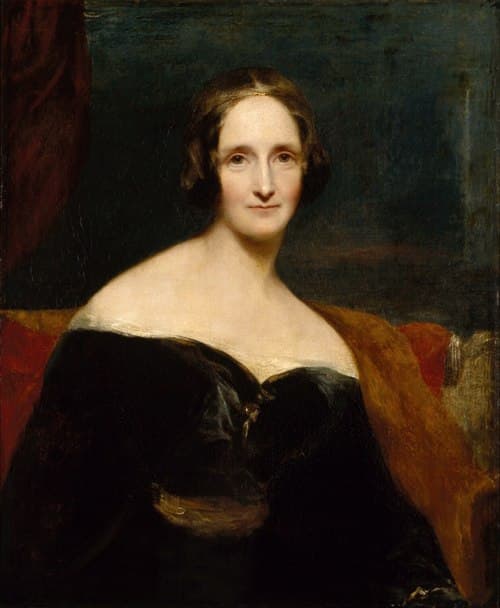
Author
Mary Shelley
- Lived
- Lived 1797 to 1851
- From
- From English
- Born in
- Born in London, England
Born Mary Wollstonecraft Godwin on August 30, 1797, in London, she entered the world under the shadow of death: her mother, the pioneering feminist philosopher Mary Wollstonecraft, died of puerperal fever eleven days after giving birth. Her father was the radical political philosopher William Godwin, who raised her in a household frequented by Coleridge, Lamb, and the leading intellectuals of the age. At sixteen she eloped to France with the married poet Percy Bysshe Shelley, beginning a turbulent partnership marked by constant debt, social ostracism, and devastating loss , three of their four children died in infancy. During the famous summer of 1816 at the Villa Diodati on Lake Geneva, where Lord Byron challenged his guests to each write a ghost story, the eighteen-year-old Mary conceived Frankenstein; or, The Modern Prometheus (1818), a novel that invented science fiction, interrogated the ethics of creation, and gave the modern world one of its most enduring myths. She published it anonymously at twenty; many reviewers assumed a woman could not have written it. After Percy drowned in a sailing accident in the Gulf of La Spezia in 1822, she returned to England as a widow at twenty-four with an infant son and devoted herself to a prolific literary career, producing the novels Valperga (1823), The Last Man (1826) , an apocalyptic vision of plague destroying civilization , and Lodore (1835), as well as editing and annotating her late husband’s poems for posterity, ensuring his reputation. She died of a brain tumor on February 1, 1851, in London, at the age of fifty-three.
As a girl she spent hours at her mother's grave in St Pancras churchyard, reading the books of Mary Wollstonecraft, the feminist who had died days after giving birth to her. There, among the headstones at sixteen, she and the married Percy Shelley began to meet in secret and fell in love.
The first button needs the app on this device; the second gets it there.
In the canon
- Frankenstein1818
- Valperga1823
- The Last Man1826
- Lodore1835
- Mathilda1959
- Matilda1959