
Author
Matsuo Bashō
- Lived
- Lived 1644 to 1694
- From
- From Japanese
- Born in
- Born in Ueno, Iga Province, Japan
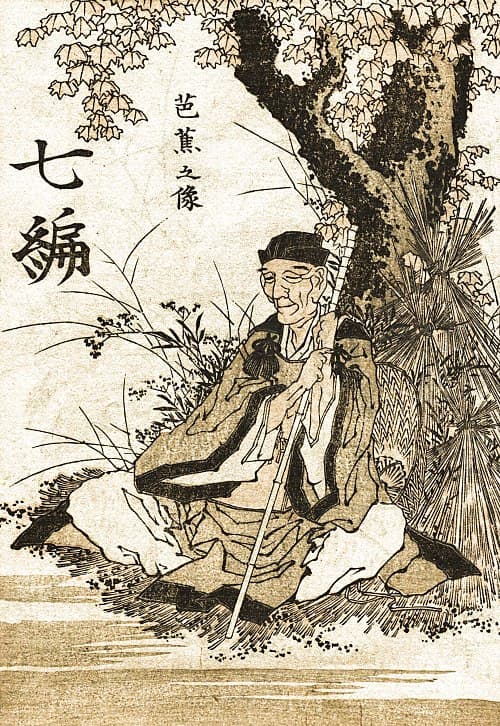
Born Matsuo Kinsaku in 1644 in Ueno, Iga Province (present-day Mie Prefecture), into a family of minor samurai rank, Bashō was introduced to poetry as a young servant-companion to Tōdō Yoshitada, the son of the local lord, with whom he studied the fashionable Teimon school of haikai. When Yoshitada died suddenly in 1666, the grief-stricken Bashō abandoned samurai service and wandered to Kyoto, where he immersed himself in classical Chinese and Japanese poetry. By 1672 he had moved to Edo (modern Tokyo), where he attracted a growing circle of students and established himself as a haikai master. He took his pen name from the banana plant (bashō) that a student had planted outside his modest hut beside the Sumida River. Dissatisfied with the witty, word-game quality of contemporary haikai, he revolutionized the form by infusing it with the spiritual depth of Zen Buddhism, the loneliness of Chinese recluse poetry, and an attentiveness to the natural world so precise it became a new kind of seeing. His travel journal The Narrow Road to the Interior (Oku no Hosomichi, 1689), recording a five-month, 1,500-mile journey on foot through northern Honshū, is considered the finest work of Japanese prose literature. Other travel writings include Records of a Weather-Exposed Skeleton (1684) and The Records of a Travel-Worn Satchel (1688). His most celebrated verse , "The old pond / A frog jumps in / The sound of water" , distilled an entire aesthetic philosophy into seventeen syllables. He died on November 28, 1694, in Osaka, while on yet another journey, surrounded by students to whom he offered a final poem about dreaming across withered fields.
In the spring of 1689, at forty-five, Bashō sold his hut on the Sumida River and wrote his will, uncertain he would return. He and his student Sora walked into the wild northern provinces for five months, covering some 2,400 kilometers on trails few travelers attempted, gathering the poems of The Narrow Road to the Deep North.
Falling sick on a journey, my dream goes wandering over a withered field.
The first button needs the app on this device; the second gets it there.
In the canon
- Bleached Bones in a Field1685
- Backpack Notes1687
- Sarashina Diary1688
- The Narrow Road to the Deep North1689
- On Love and Barley: Haiku1694