
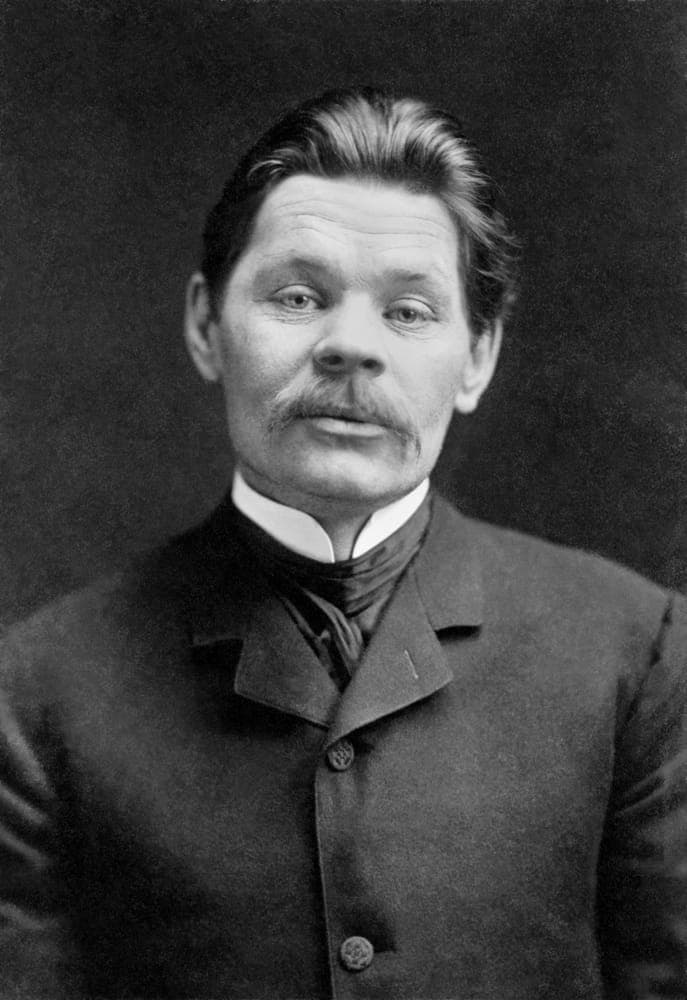
Author
Maxim Gorky
- Lived
- Lived 1868 to 1936
- From
- From Russian
Born Alexei Maximovich Peshkov on March 28, 1868, in Nizhny Novgorod, on the Volga, he was orphaned by the age of eleven and raised by grandparents whose turbulent household he later rendered in unsparing detail. His grandfather, a dye-works owner sliding into ruin, beat him; his grandmother told him the folk tales that became his first literature. Apprenticed out as a boy, he worked as a dishwasher on a steamer, a baker, an icon-painter's errand boy, and a tramp who walked thousands of miles across the Russian Empire, gathering the wanderers and outcasts who fill his early stories. At nineteen, in despair, he shot himself in the chest and survived. He took the pen name Maxim Gorky, meaning Maxim the Bitter, and his first published tale, Makar Chudra, appeared in 1892. Fame came quickly with the play The Lower Depths (1902), set in a flophouse, and the autobiographical trilogy My Childhood (1913), In the World (1916), and My Universities (1923). His novel Mother (1906), written partly during a fundraising tour of the United States, became a touchstone of Socialist Realism. He befriended Lenin and Chekhov, funded Bolshevik causes, then quarrelled bitterly with the new regime over its treatment of intellectuals, leaving for Italy and settling for years at Sorrento. Stalin coaxed him home in 1932 with honors, a Moscow mansion, and the city of Nizhny Novgorod renamed Gorky. He presided over the first Soviet Writers' Congress in 1934. He died on June 18, 1936, near Moscow, at the age of sixty-eight, officially of pneumonia, though the show trials that followed alleged he had been poisoned by his doctors.
The first button needs the app on this device; the second gets it there.
In the canon
- The Lower Depths1902
- Mother1906
- My Childhood1913
- Fragments from My Diary1924
- The Artamonov Business1925