
Author
Michel de Montaigne
- Lived
- Lived 1533 to 1592
- From
- From French
- Born in
- Born in Périgord, France
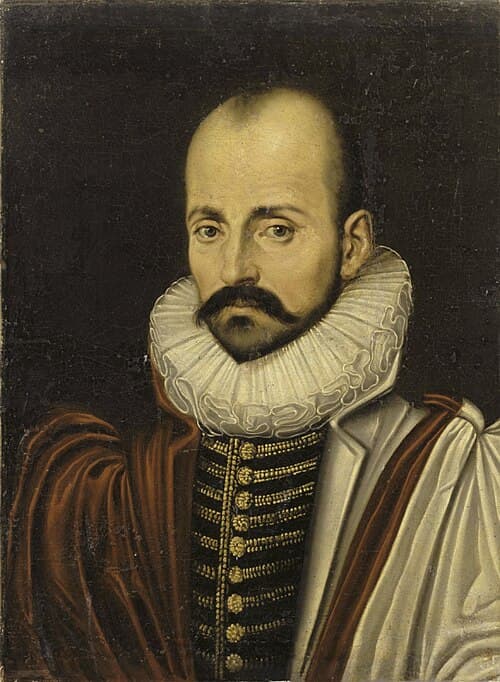
Born Michel Eyquem on February 28, 1533, at the Château de Montaigne in Périgord, southwest France, he was the son of a Catholic father of merchant origins who had been elevated to the minor nobility and a mother of Spanish-Jewish descent. His father, Pierre Eyquem, conducted a remarkable pedagogical experiment: the infant Michel was placed in the care of a German-speaking tutor who spoke to him only in Latin, so that the ancient tongue became his first language, and he did not learn French until the age of six. He studied law, likely at the University of Toulouse, and served as a magistrate in the Parlement of Bordeaux from 1557 to 1570, where he formed a passionate intellectual friendship with Étienne de La Boétie, whose sudden death from plague in 1563 left a wound Montaigne would revisit for the rest of his life. In 1571 he retired to his château’s tower library, lined with a thousand books and inscribed on its beams with quotations from classical skeptics, and began writing the Essais (first published in 1580, expanded in 1588 and posthumously in 1595) , a work that invented the essay as a literary form. His motto, "Que sais-je?" ("What do I know?"), announced a method of radical self-examination that treated the shifting, contradictory self as the only honest subject of inquiry. He served two terms as mayor of Bordeaux (1581–1585) during the Wars of Religion and navigated between Catholic and Huguenot factions with characteristic pragmatism. He died on September 13, 1592, at his château, reportedly during Mass, at the age of fifty-nine.
In his late thirties, riding near his estate, Montaigne was hurled from his horse when a servant galloping a powerful mount crashed into him from behind. Carried home for dead, vomiting blood, he drifted instead through a strange sweetness, watching his own dying as if from outside it. He later mined that hour for his essay Of Practice.
The first button needs the app on this device; the second gets it there.
In the canon
- Essays1580
- An Apology for Raymond Sebond1580